

Kraken Review 2026


Kraken was founded by Jesse Powell in 2011 in San Francisco, with trading officially launching in 2013. Since then, the platform has firmly established itself among the most reputable venues for trading digital assets, and in 2014 it was added to the Bloomberg Terminal alongside Coinbase. Across its long history, Kraken has never suffered a breach of its client custody — a fact that remains one of its main strengths.
Leadership has changed since 2022. Where Kraken was once associated exclusively with Jesse Powell, in 2023 he handed the CEO role to Dave Ripley, and since October 2024 the company has been run by two co-CEOs — Dave Ripley and Arjun Sethi — while Powell became chairman of the board. In 2025, the exchange relocated its global headquarters from San Francisco to Cheyenne, Wyoming, one of the most crypto-friendly regions in the United States.
The regulatory picture has also shifted dramatically. Where the 2022 review listed only the U.S. Financial Crimes Enforcement Network (FinCEN), today there is a Markets in Crypto-Assets (MiCA) license covering all 30 countries of the European Economic Area (EEA), authorization from the UK's Financial Conduct Authority (FCA), a Wyoming bank charter, and registrations in Australia, Canada, and Bermuda. At the same time, Kraken exited the Japanese market in January 2023 and, following EU sanctions, discontinued service for Russian residents. The platform remains available in more than 180 countries, offers an interface in 28 languages, and lists over 400 cryptocurrencies.
Kraken Exchange Rating
The exchange consistently ranks among the world's largest venues by trading volume, liquidity, and traffic.
| Overall Score | 7.8 |
|---|---|
 Fees
Fees
|
7 |
 Security & Regulation
|
9 |
 Markets
|
8 |
 Passive Income
|
7 |
 Account Opening
|
7 |
 Deposits & Withdrawals
|
8 |
 Trading Platforms
|
9 |
 Analytics
|
7 |
 Education
|
8 |
 Customer Support
|
9 |
 Bonuses
|
7 |
Pros and Cons
Like any crypto exchange, Kraken has both clear strengths and genuine weaknesses. Any such assessment is subjective: where one investor finds trading inconvenient, another finds ideal conditions.
Key Information
Kraken has operated since 2011, building a large user base and one of the deepest order books in the industry over that time. More details are in the table below.
| Name | Kraken |
|---|---|
| Website | https://www.kraken.com |
| Exchange Type | Centralized (CEX) + Kraken Financial bank (Wyoming) |
| Regulation | MiCA (Central Bank of Ireland, 30 EEA countries), MiFID (CySEC), FCA (UK), FinCEN + Wyoming SPDI (US), FINTRAC/OSC (Canada), AUSTRAC (Australia), BMA (Bermuda), CNV (Argentina) |
| Taker Fee | Spot (Pro) — from 0.40% down to 0.10% by volume; Instant Buy — 1%; futures — 0.05% |
| Maker Fee | Spot (Pro) — from 0.25% down to 0.00% by volume; futures — 0.02% |
| Demo Account | No |
| Minimum Deposit | Depends on the asset and funding method |
| BTC Withdrawal Limits | Depend on verification level (from thousands to tens of millions of USD per day) |
| Account Opening Time | From 10 minutes (registration) to several days (Pro verification) |
| Margin Leverage | Spot margin — up to 10x; futures — up to 50x |
| Markets | Over 400 cryptocurrencies (per CoinGecko — around 700 coins and 1,500+ trading pairs) |
| Passive Income | Staking (Flexible / Bonded / Auto Earn), opt-in rewards |
| Support Languages | 28 languages |
| Withdrawal Fee | Crypto — network fee; fiat — depends on the method (SEPA cheaper, SWIFT and cards more expensive) |
| Deposit Methods | Bank transfer (SEPA/SWIFT), cryptocurrencies, Visa/MC cards, Apple/Google Pay |
| Withdrawal Methods | Bank transfer (SEPA/SWIFT), cryptocurrencies, cards |
| Account Currencies | BTC, ETH, USDT, USDC, and others; fiat — USD, EUR, GBP, CHF, AUD, CAD |
| Promotions | Referral program (20% of fees, up to $1,000 per referral), cashback in the Krak app |

Kraken Fees and Charges
Trading fees on Kraken depend on your 30-day account volume: the higher it is, the lower the rate. It is worth distinguishing two modes up front. In the simple "Kraken" interface (Instant Buy), users pay a flat 1% plus the spread — convenient, but expensive. The professional Kraken Pro terminal works on a maker-taker model with progressive discounts, and it is the Pro fees we break down below.
If in 2022 the base Pro rate started at 0.16% maker / 0.26% taker, by 2026 the exchange had raised it to 0.25% / 0.40%. Conditions have become less favorable for small traders, and the old claim of "low fees" now holds true only for large volumes — at the top tiers, the rate still drops to 0.00% maker / 0.10% taker.
Trading fees
Kraken Pro spot fees for standard pairs are based on 30-day volume:
| 30-day volume | Maker’s fee | Taker’s fee |
|---|---|---|
| $0 — $10,000 | 0.25% | 0.40% |
| $10,001 — $50,000 | 0.20% | 0.35% |
| $50,001 — $100,000 | 0.14% | 0.24% |
| $100,001 — $250,000 | 0.12% | 0.22% |
| $250,001 — $500,000 | 0.10% | 0.20% |
| $500,001 — $1,000,000 | 0.08% | 0.18% |
| $1,000,001 — $2,500,000 | 0.06% | 0.16% |
| $2,500,001 — $5,000,000 | 0.04% | 0.14% |
| $5,000,001 — $10,000,000 | 0.02% | 0.12% |
| Over $10,000,000 | 0.00% | 0.10% |
A more favorable schedule applies to stablecoins, pegged tokens, and foreign exchange (FX) pairs (for example, USDT/USD, EUR/USD):
| 30-Day Volume (USD) | Maker’s fee | Taker’s fee |
|---|---|---|
| $0 — $50,000 | 0.20% | 0.20% |
| $50,001 — $100,000 | 0.16% | 0.16% |
| $100,001 — $250,000 | 0.12% | 0.12% |
| $250,001 — $500,000 | 0.08% | 0.08% |
| $500,001 — $1,000,000 | 0.04% | 0.04% |
| $1,000,001 — $10,000,000 | 0.02% | 0.02% |
| Over $10,000,000 | 0.00% | 0.01% |
Futures trading runs on a separate system, Kraken Futures (formerly Kraken Derivatives), with a similar volume-incentive structure. Spot and futures volumes are not combined.
| 30-Day Volume | Maker’s fee | Taker’s fee |
|---|---|---|
| $0 – $5,000,000 | 0.0200% | 0.0500% |
| $5,000,001 – $100,000,000 | 0.0175% | 0.0450% |
| Over $100,000,000 | 0.0000% | 0.0200% |
Non-Trading Fees
There is no fee to fund an account with crypto. Fiat deposits and withdrawals, however, carry a charge that depends on the method and currency: SEPA transfers within the EEA are cheap (often free or with a minimal flat fee), while international SWIFT transfers and card operations cost more. Crypto withdrawals are subject to a standard network fee that varies from asset to asset.
Average Fees Compared to Competitors
| Trade | Kraken | Binance | Bybit |
|---|---|---|---|
| Taker (base tier) | 0.40% | 0.10% | 0.10% |
| Maker (base tier) | 0.25% | 0.10% | 0.10% |
At the base tier, Kraken's fees are now noticeably higher than at Binance and Bybit, where spot trading starts at around 0.10%. Kraken's advantage appears only at large volumes: above $10 million per month, makers trade with a zero fee and takers pay just 0.10%. In short, the platform has become geared primarily toward large, active traders, while for beginners with small balances, competitors' terms look friendlier.
Margin Lending
Spot margin trading is available with leverage up to 10x (versus the former 1:5), and in May 2026 Kraken launched regulated spot margin for retail clients in the United States. On futures, leverage reaches 50x. When opening or holding a margin position, the margin fee is charged on top of the trading fee: an opening fee plus a rollover charge every 4 hours.
| Instrument | Opening Fee | Rollover Fee (per 4 hours) |
|---|---|---|
| BTC | from 0.01% | from 0.01% |
| ETH | from 0.02% | from 0.02% |
| Altcoins | around 0.02% | around 0.02% |
Rates are indicative: exact values for each pair depend on the quote currency and are published on the exchange's website.
Kraken Security and Regulation
Kraken's founder is Jesse Powell, and the exchange is owned by Payward, Inc. In 2025, the company relocated its global headquarters to Cheyenne, Wyoming. The exchange's security has never failed throughout its existence: no major breach of client funds or custody has been recorded. Investor assets are held primarily in cold wallets, two-factor authentication (2FA) is available, and a dedicated team of experts continually tests the platform's defenses.
The only notable incident in recent years occurred in June 2024: "researchers" from the firm CertiK found a bug that allowed a deposit to be credited to an account without actually completing it, and withdrew about $3 million. The episode turned into a dispute over the bounty, but the funds were returned, and the exchange's clients were not harmed — Kraken even distributed the recovered amount among its users. The same bug, it later emerged, was attempted against other platforms (Binance, OKX, Gate.io).
Kraken's regulatory standing has changed radically in recent years. The exchange obtained a MiCA license from the Central Bank of Ireland and operates legally across all 30 EEA countries; its Cyprus subsidiary, Payward Europe Digital Solutions, holds an investment-firm license under the Markets in Financial Instruments Directive (MiFID) (license 342/17); in the UK, Kraken is authorized by the FCA (including as an electronic money issuer and through the investment firm Crypto Facilities). In the United States, in addition to its FinCEN (MSB) registration, the company now has its own bank — Kraken Financial, holding a Wyoming Special Purpose Depository Institution (SPDI) charter and becoming the first digital-asset bank in U.S. history to gain a direct Federal Reserve master account. The list is rounded out by registrations in Canada (FINTRAC/OSC), Australia (AUSTRAC), Bermuda (BMA Class F), and Argentina (CNV).
A separate milestone is the SEC saga. In February 2023, the U.S. Securities and Exchange Commission (SEC) fined Kraken $30 million over an unregistered staking program and forced it to shut down staking for U.S. clients. In November 2023, the SEC sued the exchange, alleging it operated without registration. But in March 2025, amid a change in the regulator's leadership, the lawsuit was dropped entirely — with no fine, no admission of wrongdoing, and no changes to the exchange's operations. Shortly afterward, Kraken brought staking back for U.S. clients as well.
Finally, in 2022 management promised to take the exchange public through a direct listing of shares. That plan never materialized in that form, but by late 2025 Kraken took the conventional route: on November 19, 2025, Payward confidentially filed a draft registration statement (Form S-1) with the SEC, taking the first step toward an initial public offering (IPO).
Proof of Reserves
Kraken has carried out cryptographic Proof of Reserves since 2014, and since 2025 it publishes them quarterly (attestations for June, September, and December 2025). The mechanism is built on a Merkle tree: using an open-source tool, each client can confirm that their balance is included without revealing personal data, while an independent auditor verifies that the exchange's on-chain assets fully cover its obligations to clients. The check covers not only spot but also margin, futures, and staking balances for major assets (BTC, ETH, SOL, USDC, USDT, XRP, ADA).
Kraken Markets and Products
Today, over 400 cryptocurrencies trade on Kraken (per CoinGecko, around 700 coins across more than 1,500 trading pairs), along with seven major fiat currencies:
- U.S. dollar (USD)
- Euro (EUR)
- British pound sterling (GBP)
- Swiss franc (CHF)
- Australian dollar (AUD)
- Canadian dollar (CAD)
- Japanese yen (JPY)
Pros and Cons of Kraken's Market Selection
Kraken markets
| Kraken | Binance | Bybit | |
|---|---|---|---|
| Total cryptocurrencies | 400+ | 400+ | 600+ |
| Bitcoin | Yes | Yes | Yes |
| Ethereum | Yes | Yes | Yes |
| Altcoins | Yes | Yes | Yes |
| Futures and options | Yes | Yes | Yes |
| Tokenized stocks | Yes | No | No |
| NFT | No (marketplace closed) | Limited (BNB Smart Chain and Ethereum only) | No |
Cryptocurrencies (Spot)
All major assets are represented on spot — Bitcoin (BTC), Ethereum (ETH), Solana (SOL), XRP, Cardano (ADA), Bitcoin Cash (BCH), Polkadot (DOT) — as well as the stablecoins USDT and USDC and dozens of altcoins. Supported fiat currencies include USD, EUR, GBP, CHF, AUD, CAD, and JPY. In terms of liquidity depth on the main pairs, Kraken remains among the market leaders.
Cryptocurrencies (Derivatives)
Kraken Futures lets you trade perpetual and fixed-term contracts on dozens of cryptocurrencies, including BTC, ETH, SOL, XRP, LTC, and others, with leverage up to 50x. After acquiring the NinjaTrader platform in 2025 and the regulated derivatives exchange Bitnomial, Kraken gained access to regulated futures in the U.S. market.
New Directions in 2024–2026
Over the past two years, Kraken has transformed from a "classic" spot exchange into a financial holding company building bridges between crypto and traditional finance. The key directions:
- xStocks (tokenized stocks). Launched in 2025; by March 2026 there were already 100+ tokenized U.S. stocks and exchange-traded funds (ETFs) with more than $25 billion in volume. They trade on the Ethereum, Solana, Ink, and Ton blockchains, and Kraken also launched the world's first regulated perpetual futures on tokenized stocks. The exchange bought xStocks' issuer, Backed, in December 2025.
- Krak. A standalone payments app with a Mastercard debit card (late 2025): no currency-conversion fees, 1% cashback in bitcoin, and yields of up to 10% on DeFi instruments. Transfers are available across 160+ countries and 300+ assets.
- Kraken Wallet. A self-custodial (non-custodial) wallet launched in 2024 — users control their own keys.
- Ink. Kraken's own Layer 2 (L2) blockchain on the Optimism stack (OP Stack); mainnet launched in December 2024.
- Acquisitions ahead of the IPO. In addition to NinjaTrader ($1.5 billion) and Bitnomial, Kraken acquired the Small Exchange, which holds a Commodity Futures Trading Commission (CFTC) license, the xStocks issuer Backed, and the payments company Reap. All these deals strengthen the exchange's regulated infrastructure ahead of going public.
Passive income on Kraken
Kraken's main passive-income tool is staking, and its fate in recent years has been closely tied to regulation. After the SEC fine in February 2023, the exchange was forced to shut down staking for U.S. clients, and in January 2025, after the lawsuit was dropped, it brought the service back — U.S. clients now have access to 17 assets across 37–39 states.
Staking is currently offered in three modes:
- Flexible — no lock-up period; assets can be unstaked at any time;
- Bonded — higher yields, but after unstaking an on-chain unbonding period of 3+ days applies;
- Auto Earn — automatic yield accrual on idle assets.
Approximate yields depend on the asset: ETH around 1.1–2.8% per year, the stablecoins USDC/USDT around 4% per year, and on some assets rates reach double digits (for example, AVAX up to 10% as a promotion). One important nuance: Kraken takes a 20–30% commission on the rewards earned, so the actual yield for the user is lower than the headline figure.
| Asset | Approximate Annual Yield | Mode |
|---|---|---|
| Ethereum (ETH) | ~1.1–2.8% | Flexible / Bonded |
| Solana (SOL) | ~5–7% | Flexible / Bonded |
| USDC / USDT | ~4% | Opt-In / Auto Earn |
| AVAX | up to 10% (promo) | Bonded |
Opening an Account on Kraken
Registering an account takes about 10 minutes. But there is one condition many users consider the platform's main inconvenience: simple registration does not grant access to trading — for that, you must complete verification. Unlike some platforms where know your customer (KYC) checks are required only for certain features, Kraken requires every user to complete it.
Who Can Trade on Kraken?
Kraken operates in more than 180 countries, though a number of jurisdictions are unavailable due to sanctions or local regulation. Following EU sanctions, the exchange discontinued service for Russian residents; in January 2023 it exited the Japanese market; and in the United States it does not serve residents of Maine (ME) and New York (NY). The current list of restrictions should always be checked on the exchange's website, as it changes from time to time.
How to Open an Account on Kraken:
Step-by-Step Guide
Registration proceeds in several sequential steps:
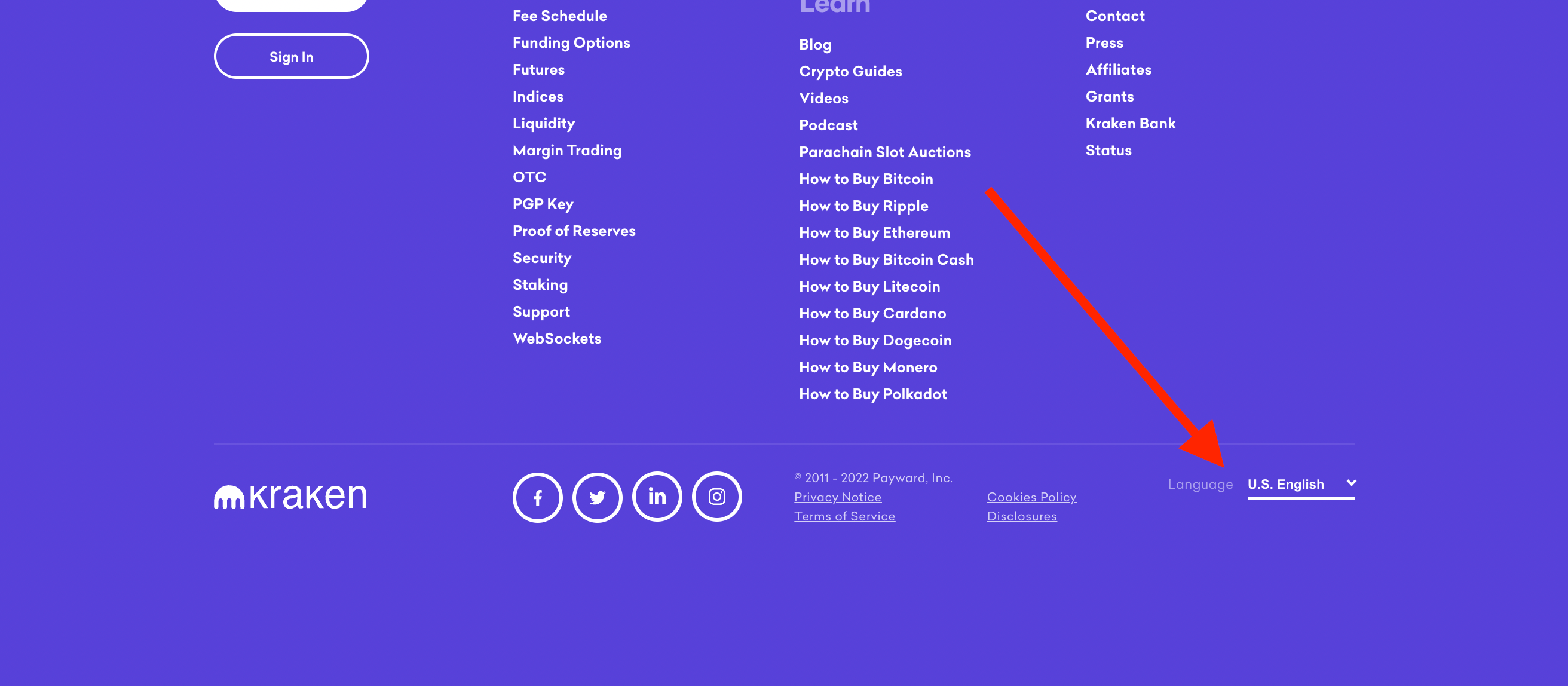
Open the official kraken.com website and, if needed, select your language in the top-right corner.
Click "Sign Up" to reach the account-creation page.
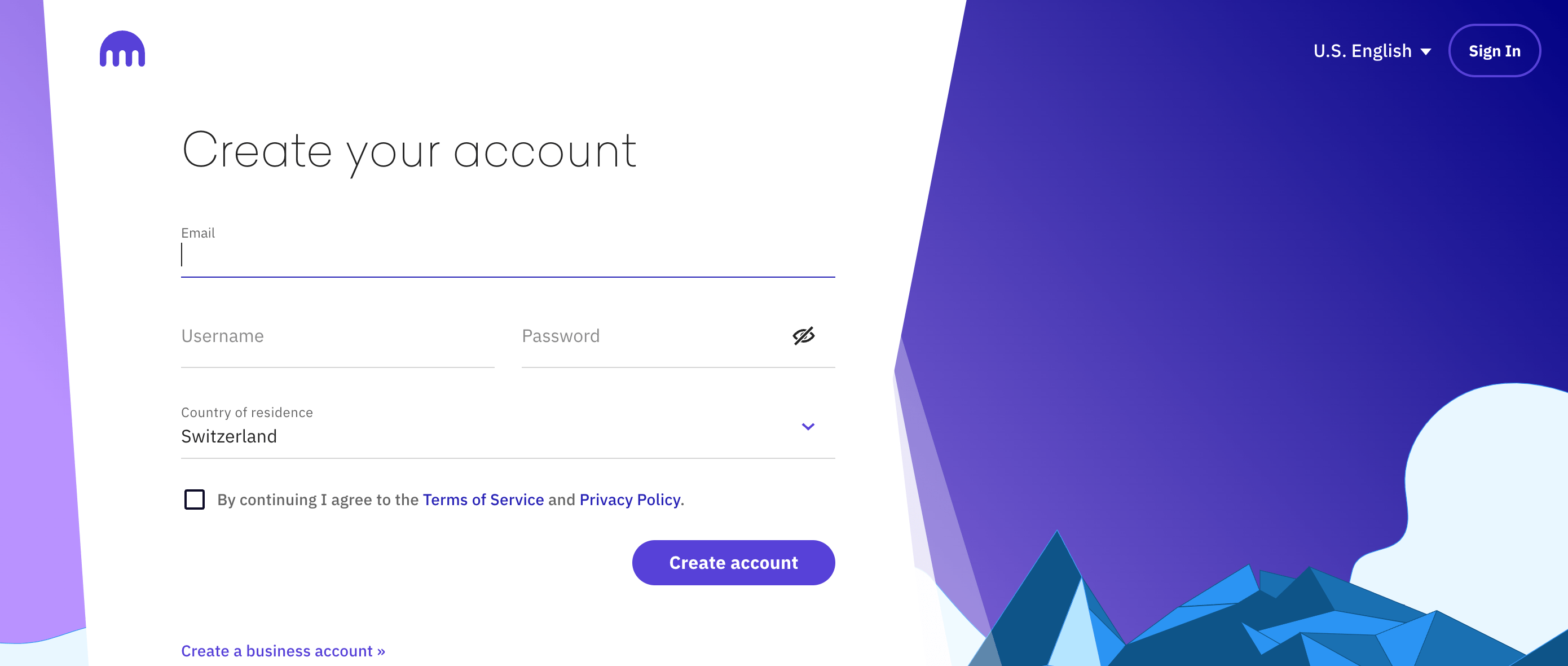
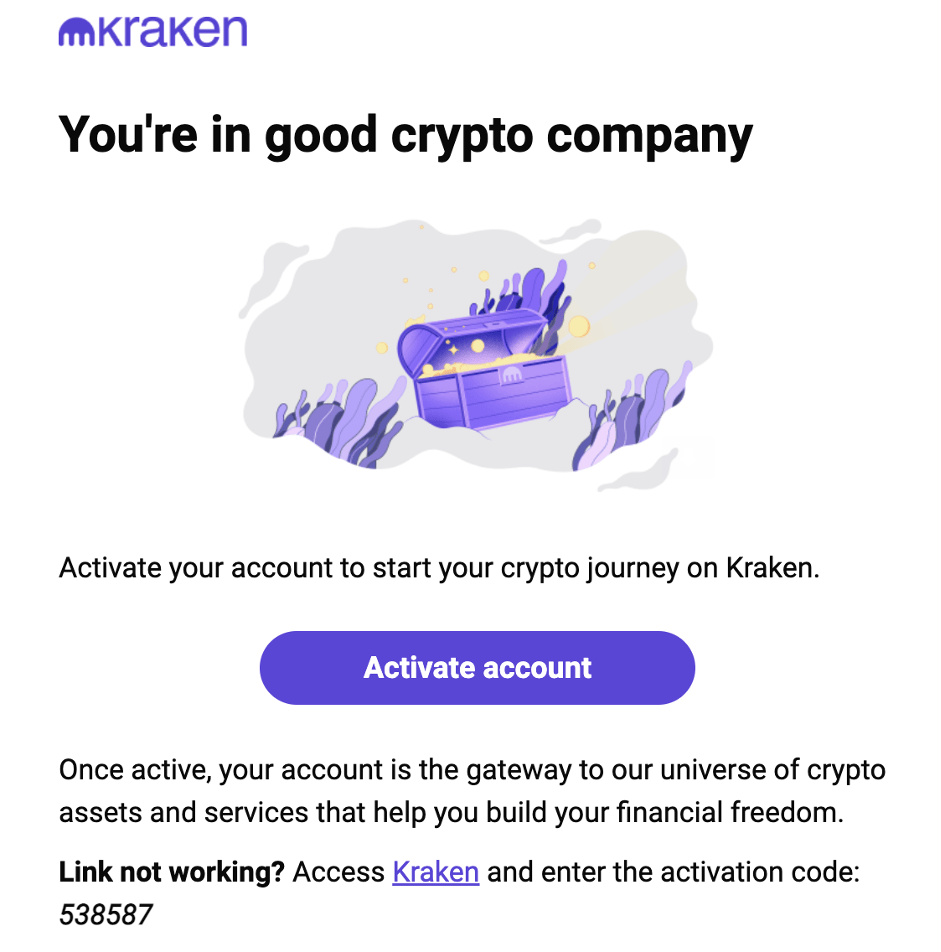
Enter your email address, create a password, and agree to the terms. A confirmation code is sent to your email.

Enter the code you received — account registration is complete.
Verification follows. In your profile settings, select the "Verification" section and an account type, then upload your documents. A passport, driver's license, or national ID works for identity verification; for proof of address, a bank statement, a utility bill, or a similar document will do. U.S. citizens additionally need an SSN or ITIN.
Processing times depend on the level: the basic levels are verified automatically within minutes, while the highest (Pro) is reviewed manually and can take several days.
Minimum Deposit on Kraken
Funding an account with crypto carries no fee and is completed quickly. The minimum deposit amount depends on the specific asset and network. Fiat deposits may carry a fee depending on the method: SEPA transfers within the EEA are cheaper and faster, while international SWIFT transfers are more expensive and slower.
Kraken Account Types
Kraken uses a tiered verification system: the higher the level, the larger the deposit and withdrawal limits and the more data you must provide. The basic levels open access to trading with moderate limits and are verified automatically, while the highest level (Pro) removes most restrictions but requires proof of source of funds and an extended anti-money laundering (AML) review.
Deposits and Withdrawals on Kraken
An account can be funded with crypto or fiat; the fee depends on the method. The exchange supports the following fiat currencies:
- U.S. dollar (USD)
- Euro (EUR)
- British pound sterling (GBP)
- Swiss franc (CHF)
- Australian dollar (AUD)
- Canadian dollar (CAD)
- Japanese yen (JPY)
Crypto deposits are credited quickly, usually within a few minutes after the required network confirmations. Fiat deposit processing depends on the method: SEPA typically clears within a business day, while SWIFT can take up to several days.
Deposit and Withdrawal Methods and Processing Times
| Method | Fee | Deposit/Withdrawal processing time |
|---|---|---|
| Bitcoin | Network fee | Within an hour after confirmations |
| Ethereum | Network fee | Within an hour after confirmations |
| Bank transfer (SEPA) | Low or none | Usually within a business day |
| Bank transfer (SWIFT) | Depends on the bank | Up to several days |
| Bank cards (Visa/MC) | Varies by currency | Almost instant |
It is also worth mentioning the Krak app with its Mastercard card, which lets users spend crypto and fiat directly, with no currency-conversion fee and with cashback in bitcoin.
Kraken Trading Platforms
Kraken offers several interfaces for different needs. The simple "Kraken" app and widget are aimed at beginners: Instant Buy in a couple of clicks (but with a 1% fee). The professional Kraken Pro terminal — available on web, desktop (Windows/macOS), and mobile — is a full-fledged trading environment with advanced order types, TradingView charts, and an extended API. Derivatives are handled by the separate Kraken Futures platform.
Feature Comparison Table
| Web | Mobile | Desktop | |
|---|---|---|---|
| Two-factor authentication (2FA) | Available | Available | Available |
| Timeframe range | 1 minute to 1 week | 1 minute to 1 week | 1 minute to 1 week |
| Order types | Limit, market, stop-loss, take-profit, trailing stop, OCO | Same as web | Same as web |
| Price history | Available | Available | Available |
| Number of indicators | 90+ | Basic set | 90+ |
| TradingView charts | Available | Available | Available |
Comparison with Competitors
| Kraken | Binance | Bybit | |
|---|---|---|---|
| Web platform | Yes | Yes | Yes |
| Android | Yes | Yes | Yes |
| iOS | Yes | Yes | Yes |
| Desktop | Yes | Yes | Yes |
Trading Platform Features
Mobile apps let you track quotes and make decisions on the go. The web version and the Kraken Pro desktop client are better suited to in-depth analysis: they make it easier to work with charts, indicators, and complex orders. For quick trades, the mobile app is enough, while for detailed market study, Kraken Pro on a large screen is the better choice.
Kraken Analytics
Kraken pays notable attention to analytics. The exchange's team publishes research and market reviews (Kraken Intelligence) on its blog and in topical channels. Its YouTube channel hosts webinars where guest experts analyze the state of the industry, and its topical podcasts — available on Spotify, Apple Podcasts, and YouTube — also count as analytical work. In addition, the Kraken Pro terminal is integrated with TradingView, giving access to advanced technical-analysis tools right inside the exchange's interface.
Kraken Education
Kraken regularly publishes educational articles on crypto trading. For learning the basics, there is the Kraken Learn section with a Crypto 101 series of materials: what blockchain is, why bitcoin is volatile, and how and where to obtain it. For those who prefer video to reading, the exchange's YouTube channel offers recorded webinars and expert breakdowns — from crypto outlooks to protecting your account.
Kraken Customer Support
If a client runs into trouble, they can first look for an answer in the Help Center. The website is available in 28 languages, though parts of the Help Center are not translated into all of them, so some users may need to use the English version. If no answer is found, you can reach a support agent via live chat (a reply usually arrives within minutes) or by email; phone support is available for certain issues.
Communication Channels
Kraken posts its latest news on social media:
- X (formerly Twitter): x.com/krakenfx
- Reddit: reddit.com/r/Kraken
- LinkedIn: linkedin.com/company/kraken-exchange
- YouTube: Kraken Exchange channel
- Telegram and other official channels are linked in the footer of kraken.com
Support Languages
The website interface is available in 28 languages. Support requests can be submitted in the major ones, though the most complete Help Center and the fastest responses are in English.
Kraken Bonuses and Promotions
Kraken's main promotion is its referral program: for each referred user, you earn 20% of the trading fees they pay, up to a maximum of $1,000 per referral. The calculation includes spot trading fees and margin fees, there is no time limit, and payouts are made directly. In addition, with the launch of the Krak app came 1% cashback in bitcoin on Mastercard card spending — essentially another way to earn rewards from the exchange's ecosystem.
Summary
In the years since the previous review, Kraken has evolved considerably. The exchange changed its leadership, moved its headquarters to Wyoming, acquired its own bank with a Federal Reserve master account, and built one of the broadest collections of licenses in the industry — from MiCA across all of Europe to registrations in Australia and Bermuda. The SEC saga ended in the platform's favor, staking returned, and quarterly Proof of Reserves reinforces its long-standing reputation for reliability.
At the same time, Kraken has bet on converging with traditional finance: tokenized stocks (xStocks), the Krak neobank with a card, a series of acquisitions (NinjaTrader, Bitnomial, Backed), and IPO preparations all point to a transformation from a spot exchange into a financial holding company.
Who Kraken is right for:
- Large, active traders. At high volumes, maker fees drop to zero — which attracts players with serious capital. For beginners with small balances, however, competitors' terms (Binance, Bybit) are more favorable: Kraken's base rate has risen, and Instant Buy costs 1%.
- Those who value reliability and regulatory cleanliness. A long history without breaches, a banking license, and transparent reserves make Kraken one of the most compliant platforms in the world.
- Fans of new TradFi instruments. Tokenized stocks and the Krak neobank are something most competitors do not yet offer.
At the same time, Kraken lags in the variety of trading services: there is no native copy trading, trading bots, or P2P, and the NFT marketplace is closed. Mandatory verification and the lack of a demo account make the first steps harder. In short, Kraken is a reliable veteran platform with a strong regulatory foundation and a tilt toward institutional and TradFi products — especially well suited to large traders and investors who value transparency.