
Binance Review 2026


Binance is the largest cryptocurrency exchange by trading volume, technological sophistication, and breadth of services for active trading and investing in cryptocurrencies. Founded in 2017, it has continued to grow without interruption ever since. Changpeng Zhao (CZ) was long considered the founding force and public face of Binance, but in November 2023 he stepped down as CEO as part of a settlement with the U.S. Department of Justice. Today, the exchange is co-led by Richard Teng and Yi He, while CZ retains his status as the largest shareholder and co-founder.
Binance stands out from its competitors across many dimensions. The platform consistently records the highest trading turnover — average daily volume runs at around $65 billion — and its registered user base has surpassed 280 million. The spot market offers approximately 1,500 trading pairs across roughly 500 supported cryptocurrencies. Binance also supports an exceptionally wide range of fiat currencies — more than 50 in total.
Beyond trading itself, Binance offers an extensive suite of additional services: copy trading, automated trading bots, a launchpad for crypto startups (Launchpad and Launchpool), peer-to-peer (P2P) exchange, cryptocurrency staking, Megadrop, and much more. Clients who hold the platform's native token, BNB — which consistently ranks among the top cryptocurrencies by market capitalization — benefit from preferential trading conditions.
Binance Rating
Binance rightfully holds a leading position in the industry: taken together, all key metrics point to an exceptionally high level of service and a wide range of capabilities. The table below provides our score for each aspect of the exchange's operation.
| Total score | 9,4 |
|---|---|
 Commissions
|
8 |
 Security and regulation
|
9 |
 Markets
|
10 |
 Passive income
|
10 |
 Account opening
|
10 |
 Deposit and withdrawal
|
8 |
 Trading platforms
|
10 |
 Analytics
|
10 |
 Education
|
10 |
 Customer support
|
9 |
 Bonuses
|
9 |
Binance Pros and Cons
Binance is an industry leader — but not in every category. The exchange has many strengths, yet we will also highlight its weaknesses, as the goal of this review is to provide an objective and comprehensive picture of the platform.
Key Information
Binance enjoys wide brand recognition, partly due to an advertising presence that far outpaces its competitors. In recent years, the exchange has significantly expanded its regulatory footprint, obtaining more than 20 licenses worldwide. Here are the key facts:
| Name | Binance |
|---|---|
| Website | www.binance.com |
| Exchange type | Centralized |
| Regulation | ADGM (Abu Dhabi) — 3 licenses; 20+ licenses worldwide; Binance.US — licensed in 34+ U.S. states |
| Taker’s fee | 0.100% – 0.017% (depending on VIP level) |
| Maker’s fee | 0.100% – 0.008% (depending on VIP level) |
| Demo account | Available |
| Minimum deposit | None |
| BTC withdrawal limits | None for verified accounts |
| USD withdrawal limits | Depends on verification level (up to $2,000,000/day with full verification) |
| Withdrawal in Fiat | USD, EUR, GBP, CAD, AUD, CHF, HKD, SGD, and more — 50+ currencies |
| Time frame for account opening | From 2 minutes for basic registration; up to 2 days for full verification |
| Margin Leverage | Up to 125x on futures |
| Markets | ~1,500 spot pairs + 655 futures pairs |
| Passive Income | Simple Earn, Staking, Launchpool, Megadrop, Dual Investment |
| Support Languages | 40+ languages |
| Withdrawal Fee | Varies by cryptocurrency and network |
| Deposit Methods | Cryptocurrency, bank cards, bank transfer, P2P, Apple Pay, Google Pay |
| Withdrawal Methods | Cryptocurrency, bank cards, bank transfer, P2P, Sell to Card |
| Account Currencies | BTC, ETH, BNB, USDT, USDC, FDUSD, EUR, USD, and others |
| Promotions | Referral program, regular campaigns and contests |

Binance Commissions and Fees
Binance charges rather flexible fees. Initially their level is average, but as the volume increases they can be considerably reduced. Also, the fees are lower if you use BNB. Let’s review the pros and cons:
Binance trading fees
Binance charges fees on both spot and derivatives trading. The baseline rates are not the best in the industry — they are roughly market average — but the multi-tier VIP program allows active traders to achieve some of the most competitive conditions available. Let's review the spot market fee schedule:
| Level | 30-day trading volume (USD) | and/or | BNB balance | Maker / Taker |
Maker / Taker BNB Discount 25% |
|---|---|---|---|---|---|
| Regular User | < $1,000,000 | or | ≥ 0 BNB | 0.1000% / 0.1000% | 0.0750% / 0.0750% |
| VIP 1 | ≥ $1,000,000 | and | ≥ 5 BNB | 0.0900% / 0.1000% | 0.0675% / 0.0750% |
| VIP 2 | ≥ $5,000,000 | and | ≥ 25 BNB | 0.0800% / 0.1000% | 0.0600% / 0.0750% |
| VIP 3 | ≥ $20,000,000 | and | ≥ 100 BNB | 0.0400% / 0.0600% | 0.0300% / 0.0450% |
| VIP 4 | ≥ $75,000,000 | and | ≥ 500 BNB | 0.0400% / 0.0520% | 0.0300% / 0.0390% |
| VIP 5 | ≥ $150,000,000 | and | ≥ 1,000 BNB | 0.0250% / 0.0310% | 0.01875% / 0.02325% |
| VIP 6 | ≥ $400,000,000 | and | ≥ 1,750 BNB | 0.0200% / 0.0290% | 0.0150% / 0.02175% |
| VIP 7 | ≥ $800,000,000 | and | ≥ 3,000 BNB | 0.0190% / 0.0280% | 0.01425% / 0.0210% |
| VIP 8 | ≥ $2,000,000,000 | and | ≥ 4,500 BNB | 0.0160% / 0.0250% | 0.0120% / 0.01875% |
| VIP 9 | ≥ $4,000,000,000 | and | ≥ 5,500 BNB | 0.0110% / 0.0230% | 0.00825% / 0.01725% |
As trading volume increases, fees decrease — a significant advantage for active traders. That said, achieving meaningful reductions requires reaching relatively high volume thresholds. Let's now turn to the derivatives market (USDⓈ-M perpetual futures):
| Level | 30-Day Trading Volume (USD) | Maker Fee | Taker Fee |
|---|---|---|---|
| Regular User | < $15,000,000 | 0.0200% | 0.0500% |
| VIP 1 | ≥ $15,000,000 | 0.0160% | 0.0400% |
| VIP 2 | ≥ $100,000,000 | 0.0140% | 0.0350% |
| VIP 3 | ≥ $250,000,000 | 0.0120% | 0.0320% |
| VIP 4 | ≥ $1,000,000,000 | 0.0100% | 0.0300% |
| VIP 5 | ≥ $2,500,000,000 | 0.0080% | 0.0270% |
| VIP 6 | ≥ $5,000,000,000 | 0.0060% | 0.0250% |
| VIP 7 | ≥ $7,500,000,000 | 0.0040% | 0.0220% |
| VIP 8 | ≥ $10,000,000,000 | 0.0020% | 0.0200% |
| VIP 9 | ≥ $25,000,000,000 | 0.0000% | 0.0170% |
An additional discount is available through the BNB token: 25% off on the spot market and 10% off on futures. At the highest VIP level, futures makers trade with zero fees — one of the best offers in the industry.
Non-Trading Fees at Binance
Cryptocurrency deposits are free of charge; the only cost to factor in is the network fee. Fiat deposits carry a fee that depends on the method: bank cards cost up to 3.3%, and Apple Pay and Google Pay are similar, processed through Worldpay. Electronic payment systems such as AdvCash allow fee-free deposits.
Withdrawals do carry a fee. Each cryptocurrency and network has its own rate — for example, withdrawing USDT via TRC-20 is significantly cheaper than via ERC-20. For fiat withdrawals, fees depend on the method and currency. P2P remains one of the most cost-effective options, as Binance charges no fee on P2P transactions.
For users dealing in small amounts, the fixed withdrawal fee on crypto can be inconvenient; for larger sums, however, it works decidedly in the user's favor.
Average Fees Compared to Competitors
The best way to evaluate Binance's fees is by comparison:
| Binance | Bybit | OKX | |
|---|---|---|---|
| Taker (spot, base) | 0.10% | 0.10% | 0.10% |
| Maker (spot, base) | 0.10% | 0.10% | 0.08% |
| Taker (futures, base) | 0.05% | 0.055% | 0.05% |
| Maker (futures, base) | 0.02% | 0.02% | 0.02% |
Binance's fee levels are competitive. At the base tier, they are broadly in line with major competitors, while the multi-level VIP program gives active traders a clear path to some of the best rates in the industry.
Margin Lending
Binance offers clients the ability to engage in margin trading, meaning traders have access to borrowed funds provided by the exchange. The spot margin market supports leverage of up to 10x (in cross-margin mode), while futures allow up to 125x for select pairs.
Lending rates vary depending on the coin and market conditions. Rates for stablecoins are generally higher than for major cryptocurrencies. Current rates can be checked in the corresponding section on the official Binance website, as they are updated on a regular basis.
In Cross-Margin Pro mode, the margin level is calculated as the ratio of the user's total net equity to the total required maintenance margin, divided into several tiers.
Cross Margin Pro Margin Level = ∑Net Equity / ∑Maintenance Margin,Please refer to FAQ for detailed information.
Margin trading amplifies both potential profits and potential losses. Traders should exercise caution and always factor in their risk tolerance and level of experience in financial markets.
Binance Reliability and Regulation
Over more than eight years of operation, Binance has become an undisputed leader in the industry — a name recognized by anyone with an interest in cryptocurrency. The exchange's journey has not been without turbulence: there have been security incidents and regulatory clashes along the way, but Binance has consistently drawn lessons from each and strengthened its position.
Many in the industry remember CZ (Changpeng Zhao) as the unwavering face of Binance. In November 2023, however, he stepped down as CEO as part of a settlement with the U.S. Department of Justice — the company agreed to pay a fine of $4.3 billion. CZ personally paid $175 million in bail and relinquished management of the company, while retaining his status as the largest shareholder. Leadership passed to Richard Teng (formerly head of the Abu Dhabi Global Market Financial Services Regulatory Authority, ADGM) and Yi He (co-founder, responsible for business strategy). The leadership change initially triggered an outflow of approximately $956 million, but the exchange quickly stabilized and resumed its growth trajectory.
Binance Holdings Limited is incorporated in the Cayman Islands. Prior jurisdictions included Hong Kong and Malta — relocations that reflected shifting regulatory landscapes in the crypto industry. Since 2023–2025, however, the focus has shifted decisively toward active licensing: once perceived as an "offshore" exchange, Binance now holds more than 20 regulatory licenses worldwide.
Key licenses and regulatory milestones:
- ADGM (Abu Dhabi) — In December 2025, Binance became the first crypto exchange to receive a comprehensive license from the Abu Dhabi Global Market. As of January 5, 2026, three licensed entities operate under this framework: an exchange, a clearing house, and a broker-dealer.
- Binance.US — Licensed in 34+ U.S. states for serving American clients.
- Asia-Pacific — Regulatory approvals in Australia, India, Indonesia, Japan, New Zealand, and Thailand. Five additional Asian licenses are planned for 2025–2026.
- The exchange employs more than 700 compliance and anti-money laundering (AML) specialists.
On the security front, Binance's history includes several notable incidents. In 2019, hackers stole approximately $40 million in BTC — the exchange's largest breach to date — but Binance fully reimbursed affected users from the SAFU insurance fund. In December 2025, Trust Wallet — a crypto wallet owned by Binance — was compromised via malicious code injected into a Chrome extension, resulting in the theft of around $7 million. In March 2026, it emerged that a credential stuffing attack had exposed data belonging to approximately 1.5 million users, though Binance's internal servers were not breached.
In response to security challenges, Binance established the Secure Asset Fund for Users (SAFU), an insurance reserve. Originally funded through fee allocations and held in stablecoins, SAFU underwent a full conversion to Bitcoin in January–February 2026: 15,000 BTC with a combined value of approximately $1 billion. Binance has committed to replenishing the fund should its value fall below $800 million.
To verify reserve holdings, the exchange employs a Proof of Reserves (PoR) system based on zk-SNARKs and a Merkle tree. Every user can independently verify that their assets are accounted for in the aggregate balance. In January 2026, Binance updated its PoR methodology to improve accuracy, separating the exchange's own assets from client holdings.
Binance Markets and Products
Binance offers clients a very extensive list of trading instruments. While the selection is not record-breaking by sheer volume, the platform is not trying to be. Binance generally lists only those cryptocurrencies that pass a vetting process for reliability and legal standing — an approach that helps protect the platform's reputation from questionable projects.
Pros and Cons of Binance's Market Selection
Binance previously offered its own stablecoin, BUSD, pegged to the U.S. dollar. In 2023, Paxos — BUSD's issuer — halted the minting of new tokens, and support for BUSD was fully discontinued by February 2024. USDC has since become the primary stablecoin on the platform, with USDT and FDUSD also supported.
Binance Alpha 2.0, launched in March 2025, deserves special mention. This feature lets users buy on-chain tokens directly from the exchange's interface, without navigating to decentralized applications — significantly lowering the barrier to early-stage projects.
In April 2026, Binance expanded its futures lineup beyond cryptocurrencies, launching perpetual contracts on WTI crude oil (CLUSDT), Brent crude (BZUSDT), and natural gas (NATGASUSDT) with leverage of up to 100x. Earlier, in January 2026, contracts on gold (XAUUSDT) and silver (XAGUSDT) had been added. These moves signal Binance's ambition to evolve into a universal trading platform that goes well beyond pure crypto.
Binance Markets
Let's compare the trading instruments available on Binance with those offered by competitors:
| Binance | Bybit | OKX | |
|---|---|---|---|
| Total number of cryptocurrencies | ~500 | ~600 | ~350 |
| Total spot trading pairs | ~1,500 | ~1,300 | ~700 |
| Bitcoin | Yes | Yes | Yes |
| Ethereum | Yes | Yes | Yes |
| Altcoins | Yes | Yes | Yes |
| Futures & Options | Yes | Yes | Yes |
| Commodity futures (oil, gold) | Yes | No | No |
| NFT | Yes | No | Yes |
In terms of trading instrument variety, Binance ranks among the best — both in the number of listed coins and available pairs. The figures are not all-time records (Bybit, for instance, lists more coins overall), but what Binance offers is more than sufficient. A unique differentiator is the availability of futures on traditional assets — oil, gas, gold, silver — something most competitors do not offer.
Cryptocurrencies - Spot
The large number of coins listed on Binance translates into approximately 1,500 spot trading pairs — a selection virtually unmatched among competitors. At the same time, Binance management does not list every new coin indiscriminately, which is more of an advantage than a drawback: it allows time to properly assess the merits of any given project. Recently listed tokens are featured in a dedicated section, giving interested traders a clear entry point.
Cryptocurrencies — Derivatives
Binance allows traders to trade cryptocurrency futures. This is a convenient and cost-effective instrument — derivatives fees are significantly lower than their spot equivalents. The derivatives market encompasses two categories of futures:
- Perpetual (USDⓈ-M and COIN-M).
- Quarterly.
More than 655 trading pairs are available on the derivatives market. This type of trading particularly attracts high-frequency speculators. In Q1 2026, Binance's derivatives volume reached approximately $4.9 trillion — around 35% of the total market among the top 10 exchanges.
Passive income on Binance
Binance offers extensive passive income opportunities. This segment has expanded considerably in recent years: what once revolved mainly around staking and a mining pool has grown into a full ecosystem encompassing copy trading, trading bots, multiple token launch formats, and sophisticated investment products. Let's review the main options.
Binance Earn
The primary passive income platform brings together several products:
- Simple Earn (Flexible) — a flexible deposit that can be withdrawn at any time. Supports more than 300 cryptocurrencies. Yields are variable and tied to market conditions.
- Simple Earn (Locked) — a fixed-term deposit (30 to 120 days). Rates are higher than for flexible products, but funds are locked for the duration.
- ETH Staking — one-click Ethereum staking with daily reward accruals.
- SOL Staking — an equivalent product for Solana.
- Dual Investment — an advanced instrument for earning on price movements between two assets.
- On-chain Yields — DeFi yields accessible directly through the Binance interface.
Launchpad and Launchpool
Binance Launchpad is a platform for initial token offerings. It helps cryptocurrency project developers launch new tokens and raise funds by providing access to Binance's enormous user base. Launchpad applies thorough project screening and due diligence, offering investors quality entry points at early stages. More than 80 projects have been launched on the platform to date.
Binance Launchpool allows users to earn new tokens by staking their existing crypto assets. Users contribute funds to dedicated pools and receive newly issued tokens in return — a lower-risk way to participate in emerging projects.
Megadrop
A relatively new format that combines BNB locking with Web3 quest completion to earn boosted airdrops. Users lock BNB in Simple Earn (Locked) and complete tasks linked to Web3 projects, receiving enhanced allocations of new tokens as a reward..
Copy Trading
Binance offers a built-in copy trading feature that allows beginners to automatically mirror the trades of experienced traders. The platform provides a Smart Filter tool for searching portfolios by Sharpe ratio and maximum drawdown (MDD). According to platform data for the first half of 2025, 93% of futures copy trades were profitable, and more than 100,000 users recorded gains from copying derivatives trades.
Trading Bots
The platform offers built-in trading bots for both spot and futures markets. Users can choose from several strategies:
- Grid Bot — range-bound trading (suited for sideways markets).
- DCA Bot — dollar-cost averaging.
- Rebalancing Bot — automatic portfolio rebalancing.
- Arbitrage Bot — arbitrage strategies.
Bots place buy and sell orders around the clock according to preset parameters — a convenient tool for passive position management.
Binance Referral Program
Binance operates a simple and user-friendly referral bonus system that can generate solid passive income from referred clients. To participate, users generate a referral link in their personal account and share it with prospective new clients. Once a registration is completed via the link, commissions are calculated in real time and credited every hour. The system is highly customizable:
- Commission share for the referrer — set based on daily turnover, ranging from 20% to 40%.
- Cashback for the referred user — also set independently.
Separate referral links apply for the spot and futures markets, and both can be generated as QR codes.
Opening an Account on Binance
Creating a Binance account takes just a few minutes. Basic features become available immediately, but full access to all services requires passing identity verification. Document review and processing can take up to two days, after which users gain unrestricted access to the exchange's complete range of services and significantly higher withdrawal limits.
Who Can Trade on Binance?
The situation regarding client onboarding and account registration continues to evolve. Binance is accessible in more than 180 countries, though a number of restrictions apply.
Registration is fully prohibited for residents of Cuba, Iran, North Korea, Syria, Crimea, and territories of Ukraine not under government control. This list is standard across most major platforms.
U.S. residents are served by a separate entity, Binance.US, which holds its own state-level licenses.
Russia has seen significant developments. In September 2023, Binance announced the sale of its Russian business to CommEx, stating that continued operations in Russia were incompatible with its compliance strategy. However, restrictions were subsequently partially relaxed: Russian users regained access to ruble deposits via bank cards and ruble-denominated P2P trading. USD and EUR P2P trading, however, remains blocked for Russian nationals. For users in the European Union, EU sanctions regulations apply to Russian nationals holding crypto assets exceeding €10,000 — such accounts are moved to a "withdrawal only" mode.
There are no restrictions for users from Ukraine.
How to Open an Account on Binance:
aStep-by-Step Guide
To become a Binance client, visit binance.com and follow these steps:
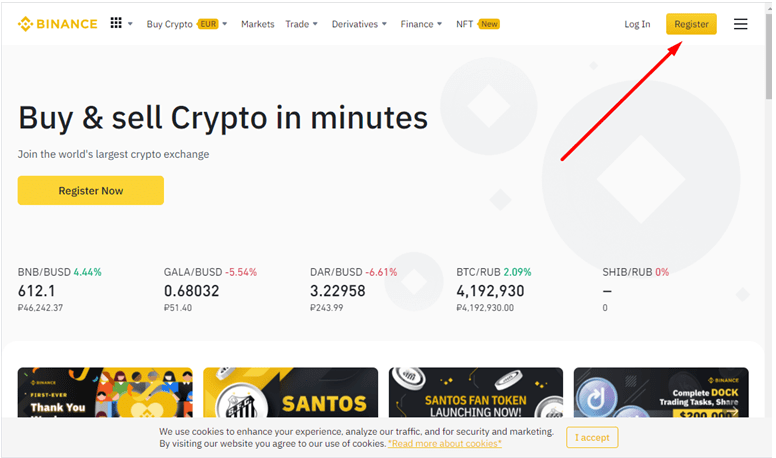
Click the registration button on the Binance website.
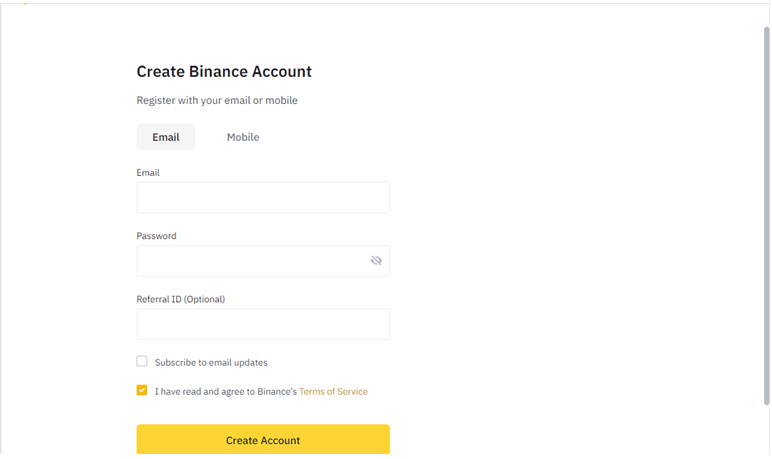
Enter your email address and create a password. Complete the anti-spam verification.
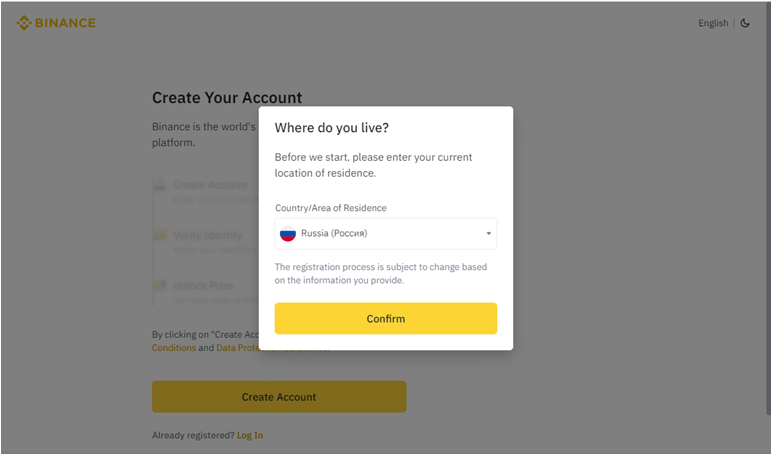
Your account has been created. Proceed to identity verification and select "Individual."
Fill in your name, country, and region of residence. Enter your mobile phone number to receive a verification SMS code. Enter your date of birth.
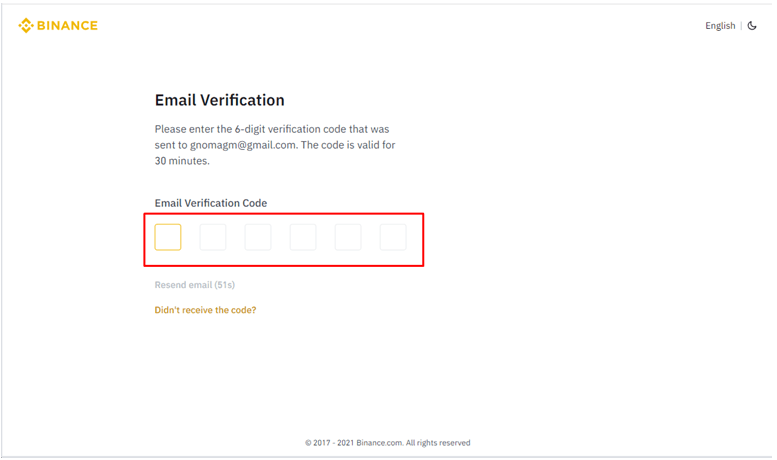
After entering the received code, you are assigned a basic verification level.
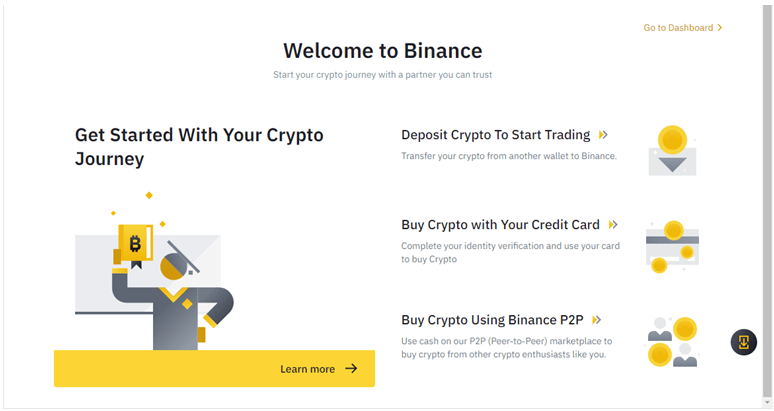
To continue with further verification, initiate the document review process.
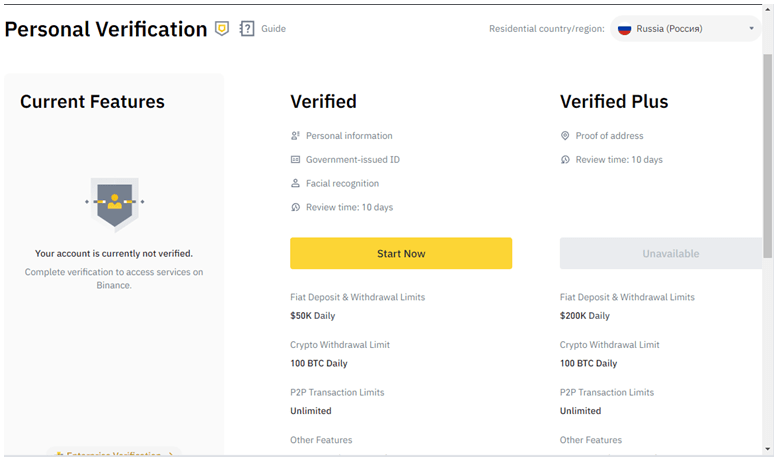
Upload all required documents and await confirmation.
As you can see, the entire process is simple and straightforward — no complications should arise. To unlock the exchange's full trading capabilities and expand your limits, proceed with full verification: upload your documents and expect a response within two days as a rule.
Minimum deposit on Binance
There is no set minimum deposit on Binance — the only constraints relate to minimum transfer amounts. For fiat deposits via third-party providers, the minimum is typically around $10–15, which can effectively be treated as a de facto minimum deposit.
Binance Account types
The trading capabilities available to Binance clients depend on the level of personal information they have provided. The main verification tiers are:
| Level | Withdrawal Limit | Requirements |
|---|---|---|
| Basic Verification | Up to $50,000/day | Email, full name, phone number, government-issued ID |
| Full Verification (Verified Plus) | Up to $2,000,000/day | Proof of residential address |
| Corporate Verification | Individual limits | Enhanced due diligence for legal entities |
Deposit and withdrawal on Binance
Binance supports one of the longest lists of fiat currencies in the industry — more than 50 in total. The most popular include:
- USD – US dollar.
- EUR – Euro.
- GBP – British pound.
- CAD – Canadian dollar.
- CHF – Swiss franc.
- AUD – Australian dollar.
- MXN – Mexican peso.
- TRY — Turkish lira
- BRL — Brazilian real
A wide range of cryptocurrencies is also supported; the key is to select the correct network when making a deposit. The most popular coins include:
- BTC
- ETH
- BNB
- USDT
- USDC
- SOL
Depositing via cryptocurrency is the most cost-effective method, as it carries no fee. Since April 2025, another convenient option has become available: purchasing crypto via Apple Pay and Google Pay, integrated through the Worldpay payment provider — particularly useful for mobile users.
P2P trading remains one of the most popular methods for both deposits and withdrawals. Binance charges no fee on P2P transactions, allowing users to exchange cryptocurrencies directly. The broad selection of payment methods and currencies enables efficient fund management at minimal cost.
In Europe, Binance has expanded its Sell to Card and Withdraw to Card features, enabling direct EUR withdrawals to a bank card.
Deposit and Withdrawal Methods and Processing Times
Here is a concise overview of available methods:
| Method | Processing Time | Fee |
|---|---|---|
| Cryptocurrency | Depends on network: from a few minutes to ~1 hour | Varies by cryptocurrency and network |
| Bank cards | Instant (deposit); 1–3 business days (withdrawal) | Up to 3.3% (deposit); varies by provider |
| Apple Pay / Google Pay | Instant | Same as bank cards (via Worldpay) |
| Bank transfer | 1–3 business days | 0% or minimal, depending on bank |
| P2P | Depends on counterparty, typically minutes | 0% (Binance charges no fee) |
Binance Trading Platforms
Binance stands apart from many other cryptocurrency exchanges by offering a dedicated desktop application. Browser-based trading is not ideal for everyone — particularly for professional traders. Given its large and diverse client base, the company provides a desktop terminal for personal computers that delivers enhanced performance and advanced functionality.
Feature Comparison Tables
A comparison of trading platforms across major exchanges reveals broadly similar core functionality. Binance distinguishes itself primarily through its dedicated desktop application, which also supports Linux.
| Web | Desktop | Mobile | |
|---|---|---|---|
| Two-Factor Authentication (2FA) | Available | Available | Available |
| Timeframe Range | 1 minute to 1 month | 1 minute to 1 month | 1 minute to 1 month |
| Order Types | Stop, limit, trailing stop, stop-market, Post Only | Full suite — limit, market, stop-limit, stop-market, trailing stop, Post Only, limit TP and SL | Basic set including stop and limit orders |
| Price History | Available | Available | Available |
| Number of Indicators | 100+ | 100+ | 30+ |
| TradingView Charts | Yes | Yes | No |
The desktop version offers the broadest functionality, fully replicating the web platform while adding extra capabilities — most notably, a wider selection of order types. Since May 2023, Binance has enabled direct spot trading through TradingView, allowing users to manage orders from within the charting platform itself.
Trading Platforms: Comparison with Competitors
| Binance | Bybit | OKX | |
|---|---|---|---|
| Web | Yes | Yes | Yes |
| Android | Yes | Yes | Yes |
| iOS | Yes | Yes | Yes |
| Desktop | Yes | No | No |
Cryptocurrency exchanges are broadly similar in the software they offer, but Binance's full-featured desktop application (for Windows and Linux) is a notable differentiator — most competitors are limited to web and mobile versions.
Binance Trading Platform Features
Despite the broadly similar functionality across platforms, there are meaningful differences worth noting. First, the features common to all versions:
- Two-factor authentication (2FA).
- Full access to the complete range of trading instruments and charting tools.
- All popular chart display types — line charts, Japanese candlesticks, and bar charts.
- Built-in technical analysis indicators, with a comprehensive selection of standard tools (MA, Stochastic, RSI, etc.).
- Graphical analysis tools — trend lines, channels, and other drawing instruments.
The web application offers all of the above, plus:
- An extended selection of order types.
- TradingView chart integration.
The desktop version provides the broadest functionality of all, with the additional ability to apply custom indicators not available in the standard list.
Binance Analytics
A dedicated YouTube channel operates for Russian-speaking audiences, actively building out its content library for several years. Key content areas include:
- Exchange news.
- Educational materials explaining the platform's mechanics and how to navigate it.
- Trading strategies and techniques.
Overall, Binance's analytical offering is commensurate with its status as an industry leader. The exchange's website features a large volume of articles and resources covering new projects, analysis of established ones, and broader exploration of the digital asset landscape. Additionally, Binance offers Binance Square — a social platform for sharing analysis, ideas, and news within the ecosystem.
Binance Education
Binance offers a dedicated educational resource, Binance Academy, featuring a wealth of articles ranging from blockchain fundamentals to technical analysis. Supplementary webinars are held on the YouTube channel.
Content for beginners is organized into categories, enabling a step-by-step exploration of what cryptocurrency is and how it works. The logical, sequential structure allows users to quickly build foundational knowledge before moving on to more advanced material — such as in-depth analyses of individual projects. Binance's educational offering is among the most extensive available online and is conveniently organized.
Topics covered include the most relevant areas in the space today: DeFi, NFT, Bitcoin Ordinals, Web3, and artificial intelligence in cryptocurrencies. Binance regularly hosts webinars on subjects ranging from crypto basics to advanced trading strategies, and collaborates with prominent experts and universities worldwide to integrate blockchain courses into academic curricula.
Binance Customer Support
Binance provides a comprehensive FAQ section covering the most common questions. If the answer isn't found there, the easiest next step is to reach out via live chat. A bot responds first and attempts to resolve the issue; if it cannot, a support agent typically follows up within a minute. A ticket submission form is also available, with email responses delivered within 24 hours. Here are the pros and cons of Binance's support:
Communication channels
Binance is active across social media platforms, where users can ask questions and access a range of useful information:
- Telegram: t.me/binanceexchange
- Instagram: www.instagram.com/Binance/
- Youtube: www.youtube.com/binanceyoutube
- Reddit: www.reddit.com/r/binance
- X (Twitter): x.com/binance
- Website: https://www.binance.com/en/support/
Support Languages
As Binance operates in more than 180 countries, its support team works in 40+ languages, including:
- Russian.
- English.
- Chinese.
- Turkish.
- Spanish.
- Portuguese.
- Vietnamese.
- Korean.
- Arabic.
- French.
- German.
- Ukrainian.
- And others.
Binance Bonuses and Promotions
Binance regularly runs a variety of contests and promotional campaigns, the terms of which may vary by region.
Referral Program — the primary ongoing bonus. Users earn commissions for bringing in new clients. Full details are covered in the "Passive Income" section above.
Limited-Time Promotions — Binance frequently runs time-limited campaigns offering enhanced interest rates on Earn products or bonuses for participating in specific trading activities.
Contests and Competitions — various competitions where users can win prizes for platform activity or achieving specific trading milestones.
Megadrop and Launchpool — these also function as bonus programs, allowing users to receive new tokens in exchange for staking BNB or completing Web3 quests.
Promotion terms and details are updated on a regular basis. We recommend checking the latest information directly on the Binance website or via official company announcements.
Summary
To sum up, there is no question that Binance is a true industry leader. In recent years, the exchange has weathered serious challenges — a change of leadership, record-breaking fines, mounting regulatory pressure — and has emerged from all of them renewed: holding dozens of licenses and with a strengthened compliance framework. While more specialized alternatives may exist in certain areas, no exchange matches Binance's overall combination of strengths across the board. Binance will be the ideal choice for:
- Active traders and speculators. Rapidly accumulating trading volume translates into significantly reduced fees, while the broad selection of instruments — including commodity futures — provides an abundance of trading opportunities.
- Those who value an integrated ecosystem. Copy trading, trading bots, Binance Earn, Megadrop, Launchpad — all in one place.
- Advocates of quality listings. Binance applies rigorous standards to new coin listings, and Binance Alpha 2.0 provides access to early-stage on-chain projects.
- Stakers and long-term investors. A well-developed passive income ecosystem with products suited to a range of risk profiles.
The one category for which Binance may be less compelling is traders operating with very small capital. The base fee of 0.1% is not well-suited to active trading with a modest deposit, and reducing it requires either holding BNB or generating significant trading volume.