

Bitget Review 2026


Bitget launched in 2018 and, in less than eight years, has gone from a young derivatives-first startup to a universal trading platform the company itself calls a UEX — Universal Exchange. At the time of writing, the exchange serves more than 150 million registered users across 150+ countries. By the close of 2025, Bitget held a 6.4% share of the global centralized exchange market — sixth place worldwide — and grew its annual trading volume by more than 45%.
Today Bitget offers spot and futures trading, copy trading, automated trading bots, margin instruments, tokenized U.S. equities via Bitget Onchain, CFD products, a standalone Web3 wallet with a debit card, and a fast-growing AI ecosystem. The spot market alone covers roughly 1,000 trading pairs and more than 570 cryptocurrencies, while the derivatives lineup includes stock perpetuals, Pre-IPO contracts, and hundreds of crypto perpetual contracts with leverage up to 125x. Fiat support is delivered through P2P, OTC, and the Bitget Wallet Card.
Legally, the exchange is registered in the Seychelles, with regional operations run through entities in Lithuania, Poland, Bulgaria, the Czech Republic, Italy, the United Kingdom, Canada, Australia, El Salvador, Argentina, Georgia, and the United Arab Emirates. As of late 2025, Bitget holds a fresh VARA license in Dubai, while its CASP application under the EU's Markets in Crypto-Assets (MiCA) framework is being reviewed in Austria. According to Chief Legal Officer Hon Ng, the company expects regulatory approval in Q2 2026; until then, Bitget formally does not offer services in the European Economic Area (EEA). Notable brand partnerships include LALIGA, MotoGP, Juventus, and a long-running collaboration with Lionel Messi.

Bitget Exchange Rating
| Overall Score | 8.5 |
|---|---|
 Fees
Fees
|
9 |
 Security & Regulation
|
8 |
 Markets
|
9 |
 Passive Income
|
9 |
 Account Opening
|
8 |
 Deposits & Withdrawals
|
8 |
 Trading Platforms
|
9 |
 Analytics
|
8 |
 Education
|
9 |
 Customer Support
|
8 |
 Bonuses
|
8 |
Pros and Cons of Bitget
Key Information
| Name | Bitget |
|---|---|
| Website | https://www.bitget.com/ |
| Exchange Type | Centralized |
| Regulation | VARA (Dubai), MSB FINTRAC (Canada), DCE AUSTRAC (Australia), VASP registrations in Lithuania, Poland, Bulgaria, Czech Republic, and Italy; license in El Salvador; registrations in Argentina, Georgia, and the United Kingdom. MiCA license (Austria) — under review, decision expected in Q2 2026 |
| Taker Fee | Spot — 0.1% (base), futures — 0.06%. Falls to 0.030% and 0.020% at VIP7 |
| Maker Fee | Spot — 0.1% (base), futures — 0.02%. Drops to 0% on both markets at VIP7 |
| Demo Account | Yes (futures only) |
| Minimum Deposit | From 1 USDT (or equivalent in another cryptocurrency) |
| BTC Withdrawal Limits | Depend on the KYC level and VIP tier; calculated dynamically in USDT equivalent |
| USDT Withdrawal Limits | Level 1: up to $3 million daily; VIP1: $4 million; VIP7: $20 million |
| Fiat Withdrawal | Available via P2P transactions and Bitget Wallet Card spending |
| Account Opening Time | Registration — about 5 minutes; Level 1 verification — another ~20 minutes |
| Margin Leverage | Up to 125x on USDT-M futures, up to 10x on isolated spot margin |
| Markets | Around 1,043 spot pairs and ~572 cryptocurrencies; hundreds of perpetual contracts and Pre-IPO derivatives |
| Passive Income | Simple Earn (Flexible and Locked), Shark Fin, Dual Investment, On-chain Elite, Launchpad, Launchpool, PoolX, LaunchX, copy trading, Bot copy trading |
| Support Languages | 15 languages: English, Spanish, Portuguese, German, French, Italian, Japanese, Korean, Chinese (Simplified), Chinese (Traditional), Turkish, Polish, Indonesian, Vietnamese, Russian, plus a separate Arabic version |
| Withdrawal Fee | Depends on the selected cryptocurrency and network; calculated at the time of withdrawal |
| Deposit Methods | Cryptocurrency, P2P, OTC, bank cards (via third-party provider), Bitget Wallet Card |
| Withdrawal Methods | Cryptocurrency, P2P, Bitget Wallet Card, OTC |
| Account Currencies | Cryptocurrencies and fiat (fiat handled via P2P and Bitget Wallet Card) |
| Promotions | Welcome pack of up to 6,200 USDT for new users, referral program, seasonal campaigns, AI hackathon, task-based bonuses |

Bitget Fees and Charges
Fee structure is one of the main reasons active traders choose Bitget. The base spot rates here match those of Binance and Bybit — 0.1% maker and 0.1% taker. On top of that base, however, Bitget stacks several discount layers: a 20% discount when paying fees with its native Bitget Token (BGB), an eight-tier VIP program from VIP0 to VIP7, and a separate PRO Program targeted at quantitative and institutional traders. At the top tier, users can fully zero out maker fees on both markets.
It is worth noting that some Bitget marketing pages still advertise "zero spot fees." In practice this refers to selected promotional pairs and time-limited campaigns; the standard rate for the majority of assets remains 0.1%. This review uses the official VIP figures from the current fee schedule rather than promotional headlines.
Trading Fees
The base spot rate for users without VIP status is 0.1% maker and 0.1% taker. Enabling BGB as the fee payment token and keeping the token in the account automatically lowers this to 0.08% / 0.08%. Beyond that, the VIP ladder kicks in — updated daily at 9:00 AM (UTC+8) based on average daily assets, 30-day trading volume, and BGB balance.
| VIP | Maker (Spot) | Taker (Spot) | Maker w/ BGB | Taker w/ BGB | Daily Withdrawal Limit |
|---|---|---|---|---|---|
| VIP0 | 0.1% | 0.1% | 0.08% | 0.08% | $3 million |
| VIP1 | 0.08% | 0.08% | 0.064% | 0.064% | $4 million |
| VIP2 | 0.065% | 0.07% | 0.052% | 0.056% | $6 million |
| VIP3 | 0.05% | 0.06% | 0.04% | 0.048% | $8 million |
| VIP4 | 0.04% | 0.05% | — | — | $10 million |
| VIP5 | 0.03% | 0.04% | — | — | $12 million |
| VIP6 | 0.02% | 0.035% | — | — | $15 million |
| VIP7 | 0% | 0.030% | — | — | $20 million |
The futures market starts from an even more competitive base. USDT-M perpetuals have a 0.02% maker and 0.06% taker rate, which drop to 0% and 0.020% respectively at VIP7. USDC-M and Coin-M contracts follow the same logic. Delivery futures do not carry a funding fee since they settle at expiration.
| VIP | Maker (Futures) | Taker (Futures) |
|---|---|---|
| VIP0 | 0.02% | 0.06% |
| VIP1 | 0.019% | 0.06% |
| VIP2 | 0.016% | 0.04% |
| VIP3 | 0.014% | 0.0375% |
| VIP4 | 0.012% | 0.035% |
| VIP5 | 0.010% | 0.032% |
| VIP6 | 0.008% | 0.030% |
| VIP7 | 0% | 0.020% |
Qualifying for VIP1 requires either $500,000 in 30-day spot volume or $5 million in futures volume, or $30,000 in assets paired with at least 12,144 BGB. VIP4 requires $30 million in spot volume or $50 million in derivatives volume and $750,000 in assets. The top VIP7 tier is reserved for users with $100 million in spot volume or $1 billion in futures volume and at least $10 million in account assets.
In 2025, Bitget also launched the PRO Program — a parallel system for algorithmic and institutional traders. Tiers here recalculate daily based on 30-day API trading volume and offer their own reduced spot and futures rates, expanded API rate limits, higher withdrawal caps, and direct access to Bitget's API team. The PRO+2 promotion ran from July 2 to August 31, 2025, automatically upgrading qualifying participants by two tiers based on June volume; in September 2025, requirements and PRO futures taker fees were updated.
A separate promotion targeted stock perpetuals: between February 10 and April 30, 2026, Bitget cut the maker fee on stock and precious-metal perpetuals to 0%, and the taker fee to as low as 0.0065%. This does not affect base crypto futures rates but illustrates how the exchange incentivizes new product categories.
Non-Trading Fees
Cryptocurrency deposits on Bitget are free: users pay only the standard blockchain network fee. Withdrawals incur a fee tied to the selected cryptocurrency and network — withdrawing USDT on TRC-20 costs a token amount, while ERC-20 withdrawals are notably more expensive because of Ethereum gas costs. P2P transactions are commission-free on Bitget's side, although payment providers or banks may apply their own fees. Bitget Convert conversions are formally free; only the market spread applies. Subscribing to any Earn product carries no fee.
In copy trading, the platform uses a profit-sharing model: the user copying a strategy pays the lead trader a share of profits, typically between 10% and 20%, set by the trader. If the position closes at a loss, no payment is made.
Average Fees Compared to Competitors
| Bitget | Binance | Bybit | |
|---|---|---|---|
| Maker (Spot) | 0.1% | 0.1% | 0.1% |
| Taker (Spot) | 0.1% | 0.1% | 0.1% |
| Maker (Futures) | 0.02% | 0.02% | 0.02% |
| Taker (Futures) | 0.06% | 0.05% | 0.055% |
Base spot rates across the three leading universal exchanges are essentially aligned — this is now an industry standard. The differences appear at the next level: the size of token-based discounts, how quickly users progress through the VIP ladder, and the final rates at the top tiers. Bitget's maximum spot discount reaches 100% off the maker fee at VIP7, while Binance and Bybit have lower-but-not-zero top-tier maker rates.
In the futures segment, Bitget matches competitors at the entry level and pulls ahead in the upper half of the VIP table. The 20% BGB-based discount applies automatically to spot trading without additional conditions, whereas BNB at Binance offers 25% but requires manual activation, and MNT at Bybit functions within a more limited mechanic.
Margin Lending
When the 2022 Bitget review was written, leveraged spot trading on the platform was not available — users could trade only with their own funds. That has changed: Bitget now operates full spot margin trading in two modes — isolated (up to 10x on major pairs) and cross (up to 3x). In isolated mode, each position lives in a separate sub-wallet: margin and liquidation are calculated for that specific pair, and a loss on one position does not affect others. Cross mode, by contrast, uses a shared margin pool, providing greater flexibility for portfolio management.
Daily borrowing rates depend on the cryptocurrency, mode, and VIP status.
| Instrument | Base Daily Rate | At VIP Levels |
|---|---|---|
| BTC | approximately 0.007% | 3–40% discount depending on tier |
| USDT | varies with market demand | 3–40% discount |
| ETH | varies with market demand | 3–40% discount |
Futures leverage works differently: it is built into the product and does not require a separate borrowing fee. Maximum leverage depends on the instrument — BTCUSDT and several major altcoins go up to 125x, ETHUSDT up to 100x, and most altcoins reach 50x–75x. Certain derivative products extend the maximum to 150x.
Bitget Security and Regulation
Security and regulatory compliance are the areas where Bitget has made significant progress in recent years. In August 2024, the exchange obtained ISO/IEC 27001:2022 certification — the international standard for information security management. Beyond internal procedures, Bitget’s infrastructure undergoes regular external security audits by CertiK and Hacken, two leading smart-contract auditing and penetration-testing firms. Since launching in 2018, Bitget has maintained a clean record with no publicly disclosed wallet compromise incidents.
A dedicated Protection Fund serves as an emergency reserve to cover losses in force majeure events — reaching $716 million in June 2025 and climbing to a record $779.7 million by July 2025. Holdings are published transparently and consist of BGB, USDT, USDC, and BTC. Additionally, Bitget Wallet maintains a separate user protection fund exceeding $300 million.
Financial transparency is reinforced through a monthly Proof of Reserves (PoR) system built on a Merkle tree structure. Any user can independently verify their account balance inclusion via open-source tools on GitHub, with reserves consistently maintained at or above 100%. As part of its Anti-Scam Month 2026 campaign, Bitget also reported returning $32.3 million in user funds intercepted from fraudulent schemes.
Bitget's regulatory footprint has evolved substantially. The previous framing around U.S. FinCEN licensing is obsolete as the United States is now a restricted jurisdiction. Active licenses and registrations as of June 2026 include:
- United Arab Emirates: VARA license (Dubai Virtual Assets Regulatory Authority), obtained in late 2025 with an operational base in Dubai;
- Canada: MSB registration with FINTRAC (excluding the province of Alberta);
- Australia: Digital Currency Exchange (DCE) registration with AUSTRAC;
- European Union: Virtual Asset Service Provider (VASP) registrations in Lithuania, Poland, Bulgaria, Czech Republic, and Italy;
- United Kingdom: Financial-services registration;
- El Salvador: Official digital asset license;
- Georgia: Digital asset license based in the Tbilisi Free Zone;
- Argentina: Formal regulatory registration.
Regarding the European Economic Area (EEA), Bitget submitted a CASP application in Austria in 2025 to align with MiCA requirements ahead of the July 1, 2026 framework deadline. While awaiting regulatory approval, Bitget formally does not offer services within the EEA.
In total, access is restricted to residents of approximately 25 jurisdictions, including the United States, Singapore, mainland China, Hong Kong, Macao, North Korea, Iran, Syria, Cuba, Afghanistan, Sudan, Alberta (Canada), and sanctioned regions of Ukraine (Crimea, Donetsk, and Luhansk).
Bitget Markets and Products
Bitget's instrument lineup has expanded so much over the past two years that calling it a "regular centralized exchange" undersells the platform. The spot market offers about 1,043 pairs and more than 572 cryptocurrencies — noticeably more than Bybit, but fewer than Binance. On top of classic spot and futures, the exchange has added Bitget Onchain (trading on-chain assets through a CEX interface), a stock perpetuals market, Pre-IPO derivatives, CFD products, spot margin with up to 10x leverage, Convert, OTC, Block Trade, and the Telegram Apps Center. The top five pairs — BTC/USDT, ETH/USDT, HYPE/USDT, SOL/USDT, and BGB/USDT — generate roughly 65% of total volume.
Pros and Cons of Bitget's Market Selection
Bitget Markets
| Bitget | Binance | Bybit | |
|---|---|---|---|
| Total cryptocurrencies | ~572 | ~430 | ~441 |
| Total trading pairs | ~1,043 | ~1,361 | ~607 |
| Bitcoin | Yes | Yes | Yes |
| Ethereum | Yes | Yes | Yes |
| Altcoins | Yes | Yes | Yes |
| Futures | Yes | Yes | Yes |
| Options | No | Limited | Yes (USDC) |
| Cryptocurrency baskets (single lot) | No | No | No |
| NFT | Only via Bitget Wallet (Web3) | Only via Binance Wallet (Web3, migration from July 3, 2026) | No |
| Tokenized stocks | Yes (Stocks 2.0, 36 names) | No (Only via bStocks, 5 names from June 11, 2026) | No |
| Pre-IPO derivatives | Yes | In preparation (SPCXB) | No |
The NFT row has shifted across the board: none of the three major exchanges currently runs a full-fledged NFT marketplace on the CEX itself. Bitget moved NFTs into the Web3 wallet from the start, Binance is migrating Binance NFT into the Binance Wallet on July 3, 2026, and Bybit shut down its NFT business on April 8, 2025 following its $1.4 billion hack. This changes the familiar picture where NFT entries used to be a uniform "Yes," and the table now reflects the current state.
Cryptocurrencies (Spot)
In the spot segment, Bitget offers a comparatively wide selection: alongside the classic BTC/USDT, ETH/USDT, BNB/USDT, and SOL/USDT, the exchange actively lists new projects and mid-cap altcoins. HYPE/USDT (Hyperliquid) stands out among the top pairs as a highly active market, and the exchange's native token BGB consistently holds a spot in the top five by trading volume. The quote base is mostly USDT, USDC, and BGB, less often BTC; there are also stablecoin–stablecoin pairs and some fiat routes through P2P.
Beyond plain spot trading, margin is now available. This is the headline change from the 2022 review: at that point, leveraged spot trading on Bitget did not exist; today it does — up to 10x in isolated mode and up to 3x in cross. To trade with borrowed funds, users transfer assets from their spot wallet to the margin wallet and pick a pair. The borrowable amount is recalculated dynamically, and rates are displayed in the account. VIP tiers automatically discount the borrowing rate.
In parallel, Bitget continues to reward holding BGB. Paying fees with the exchange's token automatically gives a 20% discount, which, combined with the VIP tier, materially changes the final rate. A BGB balance is also part of the qualification for the upper VIP levels — without it, reaching VIP3 and above is virtually impossible.
Cryptocurrencies (Derivatives)
Bitget's futures segment is one of the largest on the market. The exchange consistently ranks among the top five by perpetual contracts open interest and offers three families of derivatives:
- USDT-M perpetual — the core contracts, settled in USDT. Top pairs include BTCUSDT, ETHUSDT, SOLUSDT, XRPUSDT, DOGEUSDT, HYPEUSDT, and dozens of altcoin contracts.
- USDC-M perpetual — a similar lineup settled in USDC; useful for traders who hold USDC as collateral.
- Coin-M perpetual — contracts whose margin is held in the underlying cryptocurrency (for example, BTC/USD settled in BTC).
Maximum leverage on BTCUSDT is 125x, on ETHUSDT 100x, on most liquid altcoins 50x–75x, and on less liquid contracts 25x or lower. A separate category of products goes up to 150x — Bitget is gradually expanding this lineup. Funding fees recalculate every 8 hours and pass between long and short positions depending on the funding rate.
In 2025–2026, Bitget added a separate vertical of stock perpetuals and Pre-IPO derivatives. These are perpetual contracts pegged to the price of a tokenized share or the expected valuation of a private company. The Pre-IPO market includes contracts on OpenAI (OPENAIUSDT, launched in May 2026), a SpaceX-style equivalent, and several others. These are high-risk instruments aimed at experienced traders.
Bitget Onchain and Stocks 2.0
In 2025–2026, Bitget made a strong bet on the tokenized real-world assets segment. The Bitget Onchain platform allows users to buy and sell tokenized U.S. equities directly through a centralized exchange interface, without switching to a separate DEX application. The first wave of products, delivered through an xStocks integration, included Tesla, Nvidia, Microstrategy, the S&P 500 ETF, Circle, and Apple.
In June 2026 the exchange launched the updated Stocks 2.0 product: 36 tokenized stocks and ETFs, including Apple, Amazon, Meta, Tesla, Alphabet, Nvidia, Microsoft, QQQ, and SPY. The platform improved liquidity, the transparency of token-to-underlying mapping, and capital efficiency. Cumulative spot volume in tokenized stocks on Bitget passed $1 billion as early as January 2026, and non-crypto assets reached 20–40% of total exchange volume in Q1 2026.
Bitget Wallet
Bitget Wallet is a standalone product within Bitget's ecosystem — a self-custodial Web3 wallet that has grown to 80+ million users in 168+ countries. It is, essentially, a crypto super-app that combines non-custodial storage, cross-chain swaps, a DApp browser, an NFT marketplace, yield products, and payment services. The wallet supports 130+ blockchains and more than one million tokens, with an interface available in 16 languages.
The key difference from a Bitget exchange account is that the user owns the private keys and can interact with decentralized services directly. Built into the wallet are:
- Swap — cross-chain swaps across dozens of DEXs and bridges in a single interface.
- NFT marketplace — a Web3 storefront supporting BNB Chain, Ethereum, Solana, and other networks.
- Earn — flexible and fixed staking on top assets; for stablecoins, the Stablecoin Earn Plus program offers up to 8% APY.
- PayFi — stablecoin payments on Solana with no need to hold SOL for gas.
- RWA Swap — swaps for tokenized real-world assets, including Ondo-family tokens.
- AI trend signals and built-in AI customer support in the Help Center.
Bitget Wallet is backed by its own Protection Fund of more than $300 million, physically separated from the exchange's insurance reserve. This is intentional, ensuring that Web3 user funds do not commingle with the centralized platform's assets.
Passive Income on Bitget
Bitget's yield product lineup is one of the most extensive in the industry and has changed substantially since 2022. Beyond conventional staking, the exchange offers several launch formats, structured products, on-chain strategies, and copy trading. The overall logic is to give users a choice between predictable income, early access to new projects, and higher-risk constructs such as dual investments.
Simple Earn is the base section with two modes. Flexible allows withdrawals at any time, with yield recalculated daily. Locked fixes the deposit for 7, 14, 30, 60, 90, or 180 days at a pre-announced rate. Flexible USDT rates on Bitget have historically been moderate — from 1.06% and up; locked and advanced tiers can offer noticeably more.
Structured products include Shark Fin (with capital protection and a variable upside) and Dual Investment (a dual-currency setup where the user picks a price corridor). These are not entry-level instruments, but they appeal to traders who actively work with volatility.
On-chain Elite is a separate tab for DeFi strategies wrapped in an exchange interface. The user sees APR and conditions as in regular Earn, but funds are actually deployed into smart contracts on supported blockchains.
Bitget Launchpad is the classic format for new token launches. Every two to three weeks the exchange selects a project and invites BGB holders to subscribe. Bitget Launchpool runs in parallel: users lock BGB or another specified asset to farm a new token. PoolX is the "all-weather" version of Launchpool: new pools open almost daily and rewards are distributed hourly. LaunchX is an updated format for larger launches.
| Product | New Launch Frequency | What the User Provides |
|---|---|---|
| Launchpad | Every one to two months | BGB + subscription participation |
| Launchpool | Every two weeks | BGB or another specified asset locked |
| PoolX | Daily | Staking a designated cryptocurrency |
| LaunchX | As new projects come online | Depends on the specific launch |
Copy trading deserves a separate mention. Today Bitget is the world's largest copy trading platform by number of lead traders: more than 190,000 elite traders and over 800,000 active followers. The mechanic is classic — users filter traders by metrics (return, drawdown, trade frequency, asset class) and turn on copying. Trades replicate automatically based on the chosen margin multiplier and leverage mode. In January 2026, Bitget launched Bot copy trading — copying not live traders but vetted trading bots under a profit-sharing model.
The referral program also adds a passive income stream for long-term partners. After completing KYC, users get a referral code and receive a share of the trading fees generated by users they bring in. Inside the program there are several tiers — the more active referred users, the higher the commission rate and cashback. Bitget also provides marketing assets for social media, niche forums, and YouTube channels.
Opening an Account on Bitget
Registering on Bitget is straightforward. The user visits the site, picks a convenient method — email, phone, or Google account — and confirms the contact with a verification code. At this point the user already has access to the spot, Convert, and derivatives view sections. However, real trading without KYC is not possible: since October 2023, Bitget has moved to mandatory verification for all users.
Without identity verification, the user can only withdraw existing assets, cancel orders, and close positions. Completing KYC takes about 20 minutes, requires uploading a government-issued ID and passing a liveness check. After Level 1 approval, the user can trade across all markets, follow copy traders, participate in Launchpad, and withdraw up to $3 million per day. The second verification level is mainly needed for users planning to apply for the Bitget Wallet Card.
Account opening on Bitget
Who Can Trade on Bitget?
Bitget's geographic footprint differs significantly from the 2022 picture. Because of regulatory changes, the United States is now a restricted jurisdiction, and U.S. residents cannot use the centralized exchange. Restricted regions also include: Canada at the provincial level for Alberta (other provinces operate under the FINTRAC MSB registration), Singapore, mainland China, Hong Kong, Macao, North Korea, Iran, Syria, Cuba, Afghanistan, Sudan, and sanctioned regions of Ukraine (Crimea, Donetsk, Luhansk). In total, the service is unavailable in roughly 25 jurisdictions.
A separate situation applies to the European Economic Area. Bitget has publicly stated that it will not provide services to EEA residents until it receives a CASP license under the MiCA framework. The application has been filed in Austria, and the exchange's Chief Legal Officer expects approval in Q2 2026. As of the time of writing, no decision has been issued, so EEA residents are not currently among the active customer base.
How to Open an Account on Bitget:
Step-by-Step Guide
Registration is a linear process, and it is hard to get lost. The full step-by-step sequence is below.
On the bitget.com homepage, click the "Register" button in the top right corner. On mobile, open the hamburger menu — the registration link is at the top of the popup panel.

Pick a registration method — email, phone number, or Google account. For the first two options, enter contact details, create a password, and add a referral code if available. Choosing Google redirects to the Google account, where it is enough to confirm the authorization.
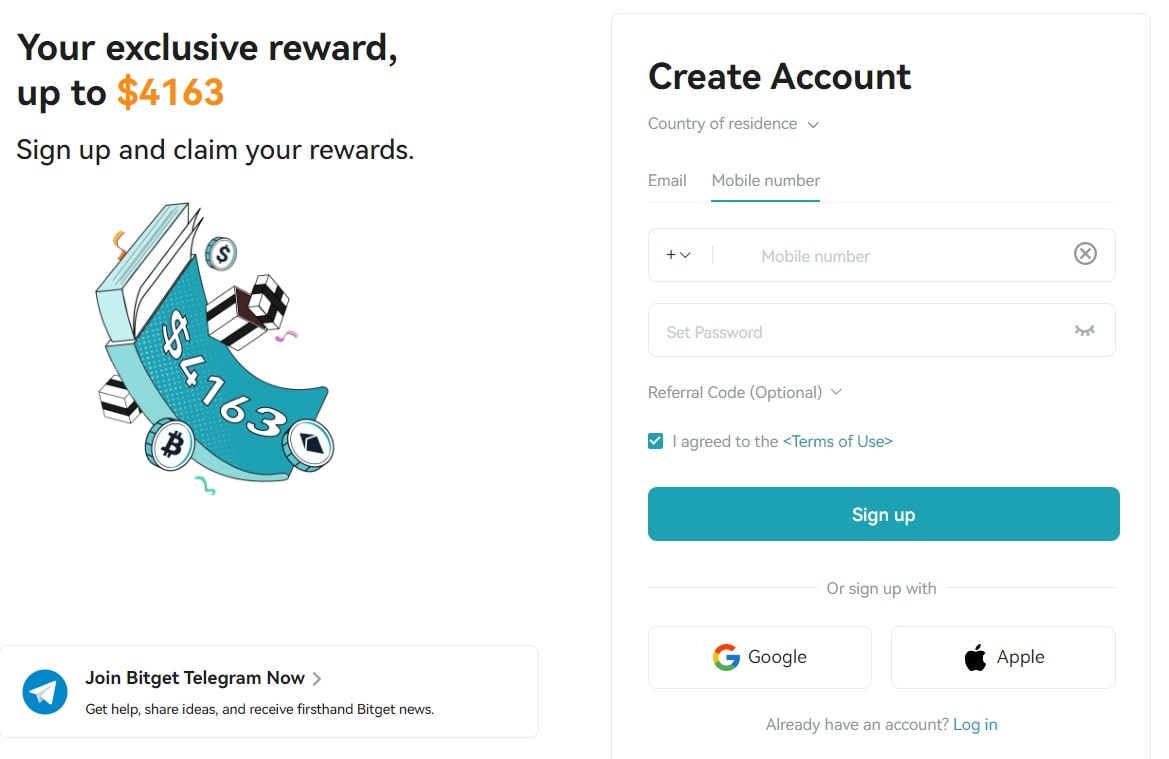
Confirm the contact. A six-digit code arrives at the specified email address or phone number. Each digit goes into its own field — enter the full code.

Complete Level 1 KYC. In the personal account, open the Verification section, pick the country, upload a document (passport or national ID), and complete facial authentication via camera. The process takes about 20 minutes on average — most of that is automated verification of photos and documents.
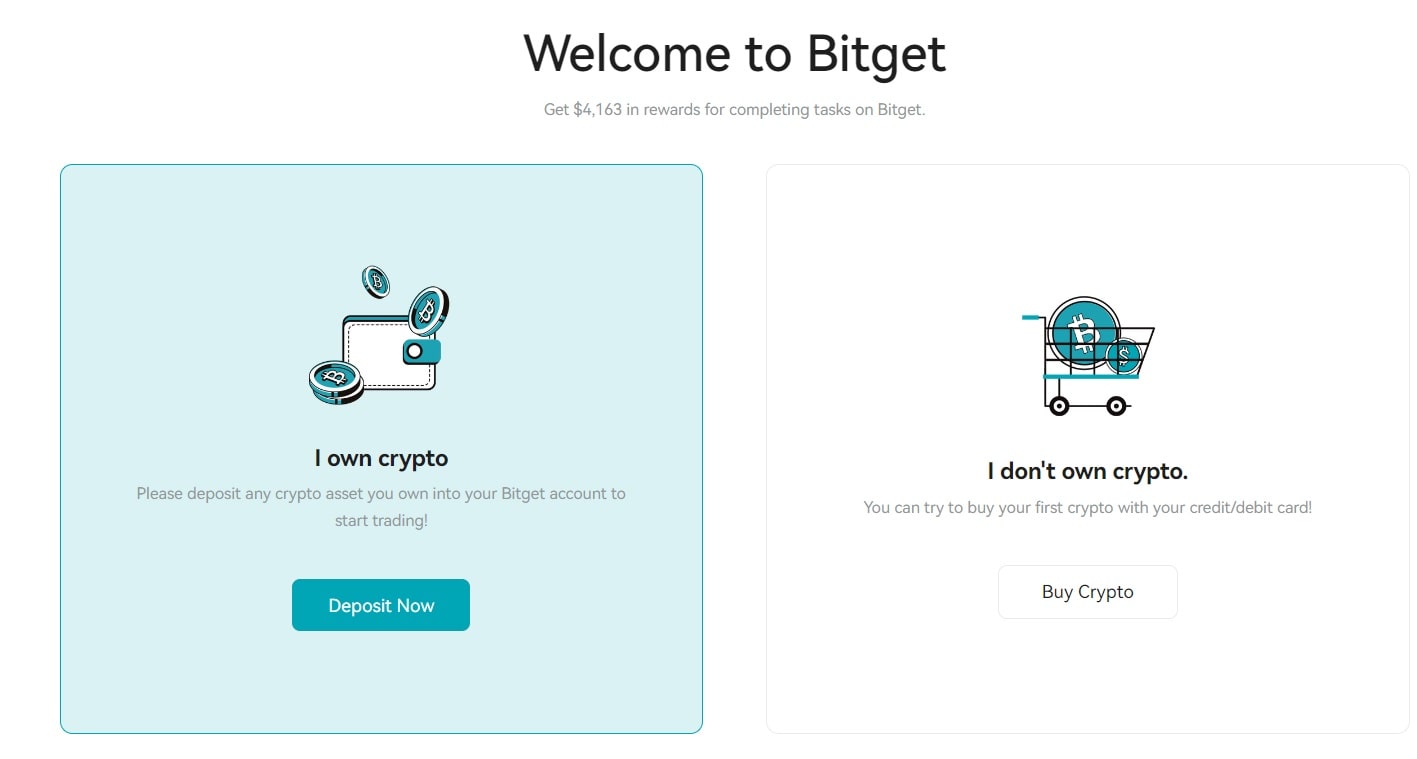
Fund the account. After KYC approval, three main funding options are available: a cryptocurrency deposit to a generated address, a P2P trade with another user, and a quick crypto purchase via a third-party card provider. The minimum deposit is 1 USDT or an equivalent in another cryptocurrency.
After funding, users can head straight to the spot or futures market, the copy trading hub, or the Earn section — everything is accessible from the top menu.
Minimum Deposit on Bitget
| Exchange | Bitget | Binance | Bybit |
|---|---|---|---|
| Minimum Deposit | from 1 USDT | from 1 USDT (network-dependent) | from 1 USDT |
The minimum entry threshold across the three major universal exchanges is essentially aligned today — it is governed by network fees rather than platform rules. In practice, allocating at least 50–100 USDT is sensible for comfortable trading: enough to test spot, futures, and copy trading without worrying about minimum order sizes.
Bitget Account Types
After KYC, Bitget automatically creates several linked wallets for different scenarios:
- Spot Account — for spot trading and holding assets for everyday operations.
- Futures Account — a separate wallet for USDT-M, USDC-M, and Coin-M contracts, with the ability to move funds in from the spot wallet.
- Margin Account — an account for leveraged spot trading: isolated and cross.
- Earn / Web3 — service accounts that display assets placed in yield products and linked to Bitget Wallet.
- Sub-accounts — sub-accounts for separating strategies, maintaining isolated trading lines, or running a team.
- Demo account — a separate mode for futures trading. Available from the top menu without creating a new wallet, uses virtual funds.
- TraderPro — an advanced interface mode for active traders: advanced order types, custom layouts, and hotkeys.
Bitget does not yet offer a Unified Account in the style of some competitors: users move funds between Spot and Futures manually, which can feel like an extra step compared to Binance or Bybit. The flip side is that this model simplifies risk separation and is convenient for traders running multiple strategies in parallel.
Deposits and Withdrawals on Bitget
Financial operations on Bitget are structured the way they are at most top exchanges. Cryptocurrency deposits arrive at individual addresses generated per blockchain and carry no fee from the exchange — the user pays only the standard network fee. Withdrawals are charged according to a schedule tied to the selected cryptocurrency and network. In addition to pure crypto routes, the platform supports P2P transactions (0% commission on Bitget's side), Fiat OTC, fast crypto purchases through third-party card providers, and the Bitget Wallet Card as a way to spend crypto in the real world.
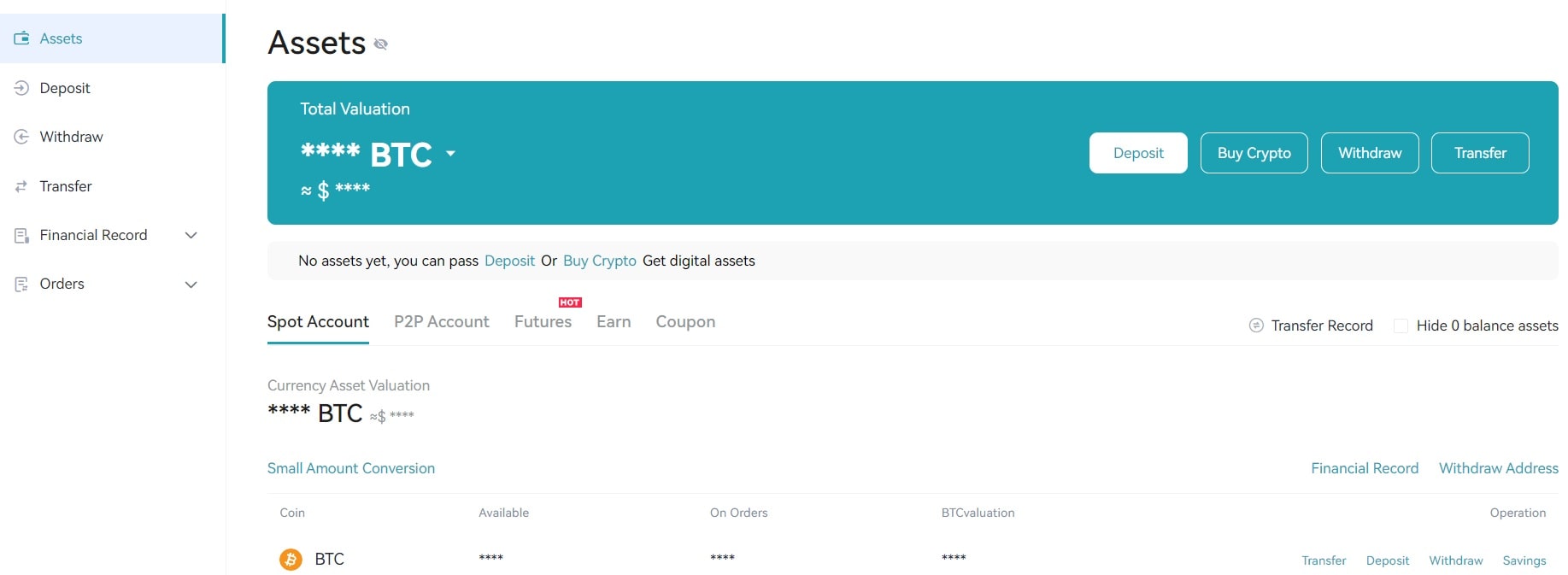
| Method | Fee | Processing Time |
|---|---|---|
| Bitcoin (BTC) | ~0.0002 BTC per withdrawal | 10–30 minutes |
| Ethereum (ETH) | ~0.002 ETH per withdrawal | 2–10 minutes |
| USDT (TRC-20) | ~1 USDT | Instant |
| USDT (ERC-20) | based on current gas | 2–10 minutes |
| Bank cards (via provider) | 1–4% (depends on provider) | Instant |
| P2P | 0% on the exchange side (payment method may charge its own) | 10 minutes to several hours |
Exact fees and limits update dynamically and are shown on the withdrawal page — network load is constantly changing. USDT and USDC support the major networks: TRC-20, ERC-20, BSC, Solana, Polygon, and others, which lets users pick the cheapest route.
Bitget Wallet Card
In 2025, Bitget launched its own crypto debit card through the Bitget Wallet infrastructure. Starting in July 2025, the Mastercard version is available in 11 Latin American countries (Argentina, Mexico, Panama, Guatemala, Bolivia, Peru, Colombia, Chile, Ecuador, Uruguay, Paraguay) in partnership with issuer Immersve. In October 2025, the Visa version launched in the Asia-Pacific region, with Mastercard following in Europe shortly after. In total, the card is available in more than 50 markets worldwide.
The base model is a USD/stablecoin-denominated card linked to the user's Bitget Wallet balance. Fiat conversion happens instantly at the point of sale, and within monthly limits the user pays zero conversion fees. Top-tier daily spend reaches $10,000, ATM withdrawals are capped at $3,000 per day, and the monthly ceiling reaches $3 million on premium tiers. The virtual card is issued free; the physical version may carry a small fee.
An additional feature is built-in yield: Bitget Wallet users earn up to 8% APY on staked stablecoins. The company brands this model "Buy Now, Pay Never" — the idea being that yield on the balance can offset day-to-day spending on the card. Issuing the card requires Level 2 KYC verification.
Trading platforms
Bitget is available across several formats. The web version is the main interface for trading and Earn products. The iOS and Android mobile app offers full functionality with push notifications and QR login. The desktop client targets traders who use two monitors and rely on heavy interface customization. In parallel, Bitget runs an API with REST and WebSocket channels and a separate TraderPro interface for active trading. TradingView integration is present across all platforms.
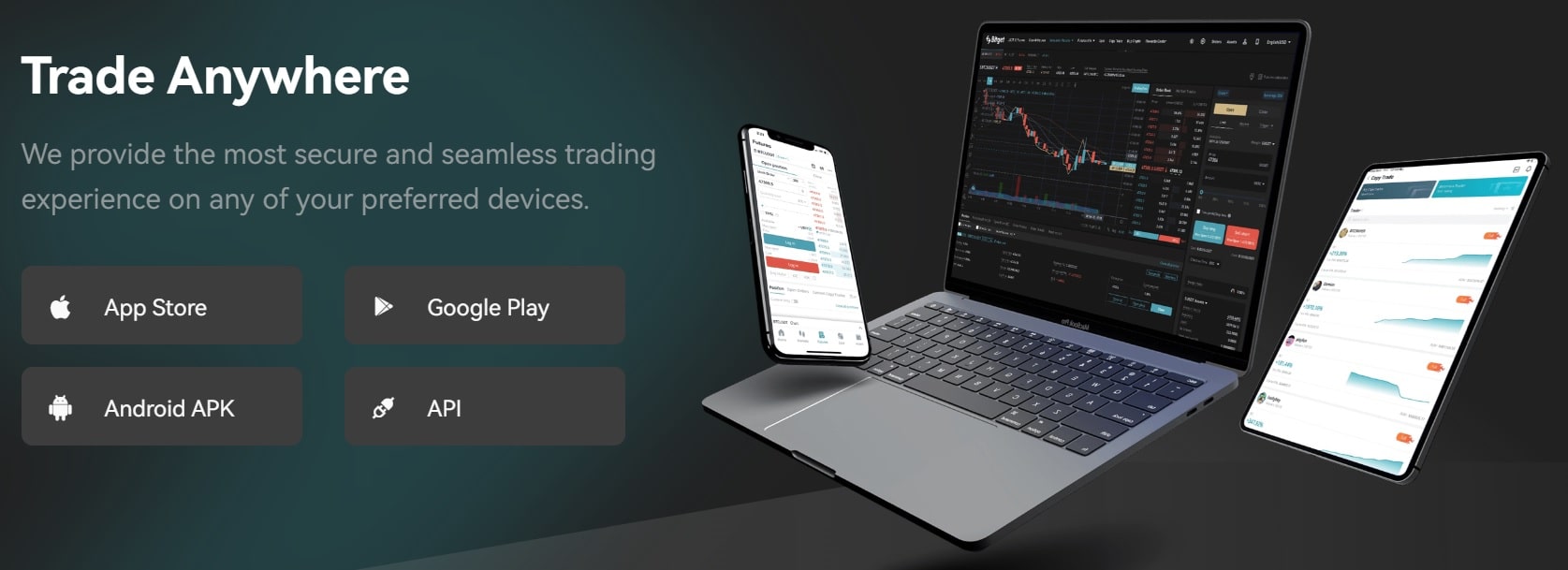
Feature Comparison Table
| Feature | Web | Mobile | Desktop |
|---|---|---|---|
| Two-factor authentication (2FA) | Yes | Yes | Yes |
| Available timeframes | 1 minute to 1 month | 1 minute to 1 month | 1 minute to 1 month |
| Order types | All available: market, limit, stop, OCO, trigger, TP / SL | All available | All available |
| Price history | Full | Access to main subset | Full |
| Indicators and technical analysis tools | 100+ TradingView instruments | 50+ instruments | 100+ instruments |
| TradingView charts | Yes | Yes | Yes |
Comparison with Competitors
| Platform | Bitget | Binance | Bybit |
|---|---|---|---|
| Web | Yes | Yes | Yes |
| Android | Yes | Yes | Yes |
| iOS | Yes | Yes | Yes |
| Desktop | Yes | Yes | Yes |
| App Store rating | 4.3 | 4.7 | 4.6 |
| Google Play rating | 4.7 | 4.5 | 4.5 |
| API (REST + WebSocket) | Yes | Yes | Yes |
| TradingView integration | Yes | Yes | Yes |
Trading Platform Features
Web. The main workstation is the web interface. The primary trading page features a full TradingView chart, order book, trade feed, order list, and order entry panel. The top menu provides switching between Spot, Margin, Futures, Onchain, Copy, Earn, and Bots. Authorization supports 2FA via Google Authenticator, hardware keys, and an anti-phishing code. In the top right corner the "Wallet" makes it easy to move assets between sub-accounts and account types.
Mobile. The Bitget mobile app consistently holds ratings of 4.3 on the App Store and 4.7 on Google Play. The interface is adapted for one-handed use: trading, copy trading, and Earn are all reachable within a few taps. Push notifications can be configured for price triggers, order execution, verification status changes, and payments. The app can be downloaded directly from bitget.com — the link is in the footer of the home page.
Desktop. The desktop version suits traders running long sessions. It matches the web interface feature-for-feature but tolerates network drops better and supports hotkey controls. There is a built-in option to collapse the chart and keep the price feed on top of all windows.
TraderPro. A dedicated mode for active traders. Includes Quick Order, custom desktop layouts, hotkey controls, and advanced order types (such as scaled orders, post-only with priority, and trailing stop with configurable step). Suits scalpers and quants who don't quite go full API trading.
API and AI Agent Hub. API access is enabled from the account settings, supports issuing keys with granular permissions and IP whitelisting. The separate PRO Program raises rate limits and withdrawal caps. Since 2026, Bitget has integrated the AI Agent Hub — a framework that lets agents securely access data and execute trades. As of May 2026, more than 1 million users use the Hub, cumulative AI-driven trading volume has surpassed $1.2 billion, and the system runs 58 tools, five analytical AI Skills, and 19 data modules.
Bitget Analytics
In 2022, there was little to highlight here — just reference articles about the platform's own products. Today Bitget offers several layers of analytical tools.
Bitget Academy has evolved from a set of FAQs into a full media portal with market overviews, product guides, strategy breakdowns, and regular columns about industry developments. Inside the Academy are dedicated tracks for futures, copy trading, and AI trading, as well as risk-management methodology.
AI Agent Hub is the main analytical accelerator on Bitget. It is the framework through which third-party AI agents connect to exchange data and can not only analyze but trade. Five analytical Skills handle market mapping, cross-validation of signals, and anomaly detection; 19 data modules deliver market indicators and on-chain metrics. The partnership with MuleRun added a personal AI assistant with natural-language query processing.
Market Insights and Square.The Square section aggregates opinion threads, posts, and analyses from traders and editors. Market Insights provides quick market overviews, open-interest dynamics across top pairs, and liquidity summaries. For futures traders, the funding rate and liquidation history dashboards are particularly useful.
Pros and cons
Education
Bitget continues to keep its "Academy" as the core of its educational content, but the catalog has changed substantially. Old "how to buy cryptocurrency" guides have been joined by practical strategy breakdowns, copy trading materials, AI tool explainers, and detailed futures tutorials. In parallel, Bitget runs the Blockchain4Youth and Blockchain4Her campaigns aimed at student and women's audiences.
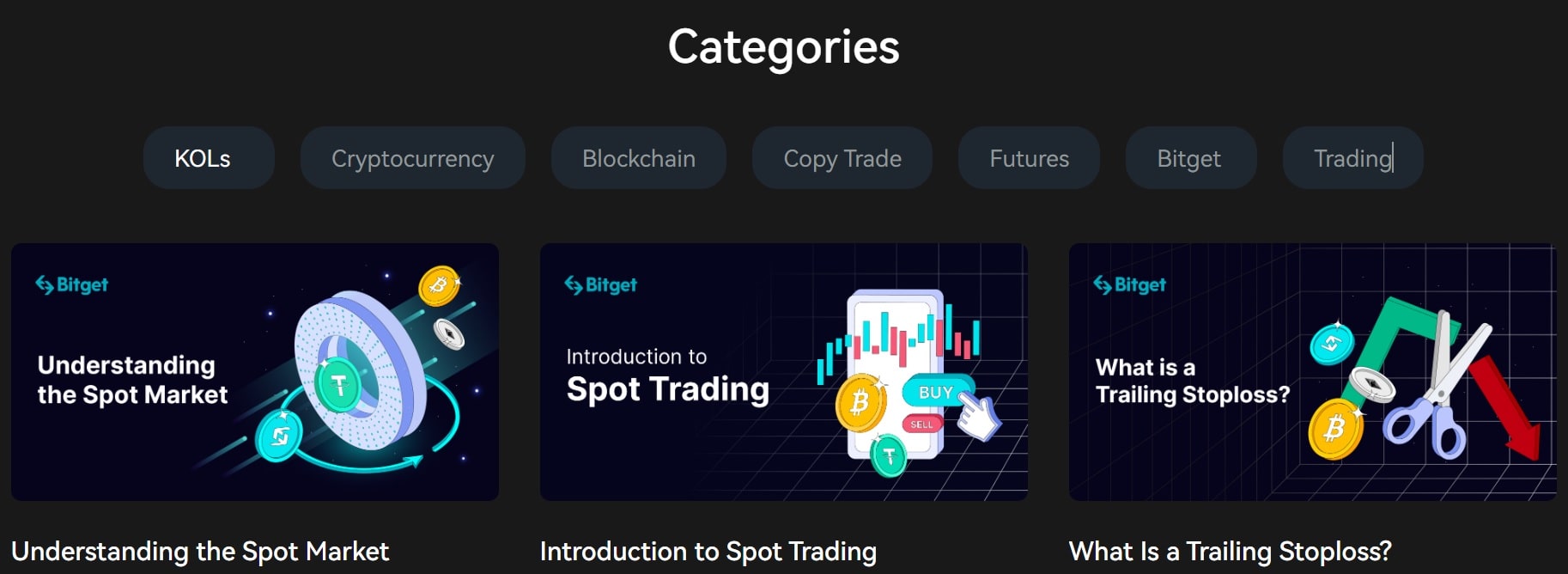
The exchange's YouTube channel is updated regularly: new product explainers, market event recaps, and trader interviews. The blog and wiki serve as a reference for terminology and technical topics. For the second quarter of 2026, Bitget has announced the world's first AI Trading Hackathon — an event that gives developers technical resources and access to Bot Hub to compete in building AI strategies.
Bitget Customer Support
Bitget's support team works 24/7 and is available across several channels. The fastest is the built-in live chat. To open it, click the "Support" icon in the bottom right corner of the web interface or the mobile app. The window first offers quick answers to common questions and then routes to a human agent. For deeper queries that require case review or screenshot attachments, email support is the better option.
Communication Channels
- Live chat — on the website and inside the mobile app (the "Support" icon).
- Email — the official support address, listed in the footer of the home page.
- Help Center — a built-in library of articles and step-by-step guides.
- AI support in Bitget Wallet — a separate channel for Web3 wallet users.
- Social media — X (Twitter), Telegram channels (including regional ones), Discord, YouTube, and Square (Bitget's in-platform social network).
- VIP and Institutional — dedicated contact lines for major clients, with direct manager access.
Customer support languages
| Language | Channel |
|---|---|
| English | Live chat, email, Help Center |
| Spanish | Live chat, email, Help Center |
| Portuguese | Live chat, email, Help Center |
| German | Live chat, email, Help Center |
| French | Live chat, email, Help Center |
| Italian | Live chat, email, Help Center |
| Japanese | Live chat, email, Help Center |
| Korean | Live chat, email, Help Center |
| Chinese (Simplified) | Live chat, email, Help Center |
| Chinese (Traditional) | Live chat, email, Help Center |
| Turkish | Live chat, email, Help Center |
| Polish | Live chat, email, Help Center |
| Indonesian | Live chat, email, Help Center |
| Vietnamese | Live chat, email, Help Center |
| Arabic | Dedicated regional website version and live chat (MENA) |
Bitget Bonuses and Promotions
Bitget actively uses bonus campaigns as part of its product strategy. New users land on a welcome pack — at the time of writing, declared at up to 6,200 USDT plus LALIGA merch. The pack composition changes regularly: it includes spot and futures trading vouchers, deposit bonuses, fee discounts, and copy trading cashback. Conditions are detailed on promotional pages and recalculated frequently — for that reason this review does not lock in specific dollar amounts from older 2022-era coupons.
The referral program remains the foundational mechanic for long-term partners. After KYC, a user receives a referral code and a share of the fees generated by the traders they bring in. The program has several tiers — the more active referred users a partner brings, the higher the commission percentage and cashback. Pre-built marketing assets are available for social media, niche forums, and YouTube channels.
Seasonal campaigns are a separate segment: alongside major launches (Bot copy trading, AI Agent Hub, Stocks 2.0) Bitget runs promotional mechanics including trading contests, BGB and stablecoin rewards, and free subscriptions to premium products. A major seasonal event in 2026 is the announced AI Trading Hackathon, with a prize pool for developers of AI strategies.
A separate highlight is Anti-Scam Month 2026: the campaign reported returning $32.3 million in user funds connected to fraud activity. This is not a classic bonus, but a direct signal that Bitget invests in user protection beyond its standard insurance mechanisms.
Summary
Over the three years separating the 2022 review from this one, Bitget has changed radically. From a growing exchange focused on copy trading, it has become the sixth-largest CEX by market share, with its own UEX — Universal Exchange — concept. The original spot and futures set has been joined by tokenized U.S. equities via Bitget Onchain and Stocks 2.0, Pre-IPO derivatives on major technology companies, spot margin up to 10x, an AI Agent Hub with a million users, and a standalone Bitget Wallet that already operates as an independent service for 80+ million people.
The platform's strengths are clear. On fees, Bitget matches Binance and Bybit at the entry level and pulls ahead at the top of the VIP table — VIP7 brings the maker rate down to 0% on both markets, while the dedicated PRO Program for quants adds advantages in API limits and withdrawal caps. Security is reinforced by ISO/IEC 27001:2022, a record-high Protection Fund of $779.7 million, monthly Proof of Reserves, and the absence of public incidents since 2018. Copy trading is the largest in the world by number of lead traders. Customer support runs 24/7 across 15 languages, with response times measured in minutes rather than hours.
Weaknesses center mainly on regulation and regions. Service is unavailable in the United States, Singapore, and several other jurisdictions. The CASP license under MiCA is still pending — the application was filed in Austria in 2025, and until it is approved Bitget formally does not operate in EEA countries. For European users, that means alternatives over the coming months remain Kraken, Bybit, Coinbase, and other platforms that already hold the license. The NFT marketplace is only available via Bitget Wallet, and several new products such as Pre-IPO derivatives require disciplined risk management — these are not beginner tools.
Who Bitget suits in 2026: first, active crypto traders who care about a low net fee and broad market coverage. Second, copy traders and bot copiers — no other exchange offers a deeper strategy pool. Third, users who want to trade tokenized equities or Pre-IPO derivatives through a CEX interface — Bitget is one of the few options available today. Finally, Web3 and DeFi enthusiasts will find it convenient to keep a unified account between Bitget and Bitget Wallet and bridge both worlds through PayFi, Earn, and RWA Swap. On the other hand, users in the United States or the EEA who want full local regulatory compliance should wait for the MiCA outcome or pick an exchange with an already confirmed license.