
 BEST EXCHANGE 2026


OKX is one of the first-wave crypto exchanges: launched in 2017 and rebranded from OKEx in January 2022, it has since evolved from a Hong Kong-based startup into a multi-jurisdictional holding with regulatory licenses in the European Union (EU), the United Arab Emirates (UAE), the Bahamas, Singapore, and the United States. Low fees, one of the widest product lineups in the industry, a mature Web3 ecosystem, and transparent reserve attestations are the main reasons traders keep returning to the platform year after year.
According to CoinGecko, OKX consistently ranks among the top-10 centralized exchanges (CEXs) by daily turnover: roughly $5–6 billion on spot and over $20 billion on derivatives. The exchange has more than 20 million registered users across 160+ countries.
Today OKX offers arguably the broadest product range in the industry: classic spot and margin, perpetual and expiry futures, options on BTC, ETH, and SOL, pre-market futures on tokens that have not yet been listed, Copy Trading, Trading Bots, and a full-featured Web3 wallet spanning 60+ blockchains. Against its peers, OKX stands out with its own Layer 2 network (X Layer) and one of the first full MiCA licenses in the world.
OKX Exchange Rating
| Overall Score | 8.5 |
|---|---|
 Fees
Fees
|
9 |
 Security & Regulation
|
8 |
 Markets
|
10 |
 Passive Income
|
9 |
 Account Opening
|
9 |
 Deposits & Withdrawals
|
8 |
 Trading Platforms
|
9 |
 Analytics
|
7 |
 Education
|
9 |
 Customer Support
|
7 |
 Bonuses
|
8 |
Pros and Cons of OKX
Key Information
| Name | OKX |
|---|---|
| Website | https://www.okx.com |
| Exchange Type | Centralized exchange (CEX) + proprietary Web3 ecosystem |
| Regulation | MiCA (Malta, MFSA) — passport across all 30 EEA countries; VARA (Dubai); DARE Act (Bahamas); MAS MPI (Singapore); DNB (Netherlands); FinCEN MSB + state-level licenses (U.S.); AUSTRAC (Australia) |
| Taker Fee | Spot — 0.1% (Global) / 0.35% (EEA); futures — 0.05% |
| Maker Fee | Spot — 0.08% (Global) / 0.20% (EEA); futures — 0.02% |
| Demo Account | Yes |
| Minimum Deposit | None; per-asset minimum deposit amounts depend on the network |
| BTC Withdrawal Limits | Depend on know your customer (KYC) tier — from approximately $10,000/day at Basic to several million at Pro |
| USD Withdrawal Limits | Equivalent range — from $10,000 to $10,000,000+ per day depending on tier |
| Fiat Withdrawal | Yes — via peer-to-peer (P2P) and banking gateways in multiple jurisdictions; direct SEPA/SWIFT in the EU, AED in the UAE |
| Account Opening Time | From several minutes to 36 hours, depending on the verification tier |
| Margin Leverage | Up to 125x on BTC/ETH futures; up to 10x on spot margin; lower (50x or below) on most altcoins |
| Markets | 350+ cryptocurrencies, 500+ spot pairs, 200+ derivatives, options on BTC/ETH/SOL |
| Passive Income | Simple Earn, Dual Investment, On-chain Earn, BTC Yield+, Flash Earn, Jumpstart |
| Support Languages | 24+ languages, including English, Spanish, French, German, Portuguese, Arabic, Chinese, and Korean (live chat, 24/7) |
| Withdrawal Fee | Per-asset and per-network basis (network fee + small flat fee) |
| Deposit Methods | Cryptocurrencies, bank cards, SEPA/SWIFT/AED, Apple/Google Pay, Banxa, P2P, OKX Pay |
| Withdrawal Methods | Cryptocurrencies, bank transfer, cards, P2P |
| Account Currencies | BTC, ETH, USDT, USDC and 300+ other cryptocurrencies; in select jurisdictions — EUR, USD, AED |
| Promotions | Multi-tier referral program, mystery boxes, Jumpstart, and partnerships with Manchester City, McLaren F1, and Cristiano Ronaldo |

OKX Fees and Charges
OKX operates a clear, multi-level fee system: each asset category has its own rate card, and user tiers are determined by 30-day trading volume. Compared with 2022, the structure has become simpler — previously, Regular-tier levels were driven by OKB balance, whereas now only trading turnover is required.
Trading Fees
On spot, OKX applies the standard Regular Lv 1–5 table. Reaching Lv 2 requires $10 million in 30-day turnover, while Lv 5 starts at $100 million.
| Tier | Requirement (30-day turnover) | Maker | Taker |
|---|---|---|---|
| Regular Lv 1 | — | 0.080% | 0.100% |
| Regular Lv 2 | ≥ $10,000,000 | 0.075% | 0.095% |
| Regular Lv 3 | ≥ $20,000,000 | 0.070% | 0.090% |
| Regular Lv 4 | ≥ $50,000,000 | 0.065% | 0.085% |
| Regular Lv 5 | ≥ $100,000,000 | 0.060% | 0.080% |
Futures and perpetual swaps carry lower baseline rates: 0.020% maker / 0.050% taker at Lv 1. Options (BTC, ETH, SOL) follow separate rules, with the fee capped at 12.5% of the premium paid.
For VIP users, OKX operates eight dedicated tiers accessible from around $5 million in monthly turnover or a significant average balance. On the top rungs, the maker fee on derivatives drops into negative territory — down to –0.005% — while the taker fee falls to roughly 0.015%. This is standard industry practice aimed at attracting major liquidity providers.
In the EEA, OKX operates on a separate fee schedule: spot — 0.20% maker / 0.35% taker at the first tier, with gradual reductions as turnover grows. This is a direct consequence of MiCA compliance, which OKX was the first global exchange to secure in full.
OKB holders get additional discounts of up to 40% on trading fees. The discount applies only to Regular tiers — VIP accounts already pay the lowest available rates and are not eligible for the OKB discount on top.
OKX eased its VIP-tier system in April 2026: effective April 8, the entry thresholds for the lower tiers were lowered (for VIP 1, by half — from $10 million to $5 million in 30-day futures turnover), while an alternative qualification path based on account assets was introduced for the top tiers, VIP 7–9. A tier is now assigned by whichever criterion is most favorable — total account balance or 30-day trading volume in any single product line. The exact thresholds are revised periodically, so they are best checked directly in the Fees section.
Non-Trading Fees
OKX does not charge deposit fees for crypto — only the blockchain network fee applies. Withdrawals combine a network fee and a small flat fee calculated per asset and per network. For popular channels such as BTC, USDT-TRC20, or SOL, the total withdrawal cost typically stays within $0.50–$2.
Fiat rules depend on jurisdiction. Buying crypto with a bank card through third-party gateways (Banxa, Moonpay, Apple Pay, Google Pay) typically costs about 1.5–3% on top of the market rate. SEPA transfers in Europe and AED in the UAE carry no OKX fee, although the sending bank may charge its own. P2P trading on OKX has zero platform fee — the cost is embedded into the maker's spread.
Average Fees Compared to Competitors
| OKX | Binance | Bybit | |
|---|---|---|---|
| Taker (spot, base tier) | 0.10% | 0.10% (0.075% when paid with BNB) | 0.10% |
| Maker (spot, base tier) | 0.08% | 0.10% (0.075% when paid with BNB) | 0.10% |
| Taker (futures, base tier) | 0.050% | 0.050% | 0.055% |
| Maker (futures, base tier) | 0.020% | 0.020% | 0.020% |
On the spot market, OKX has a clear edge on the maker rate — 0.08% versus 0.10% on competitors, and the OKB discount can push it down further by up to 40%. On derivatives, all three exchanges run neck and neck, though OKX is marginally cheaper than Bybit on reverse swaps (0.050% vs 0.055%). Taken together across all fee tiers, OKX remains one of the cheapest top-tier exchanges — particularly for active traders with substantial turnover.
Margin Lending
Full margin trading is available on OKX. As in 2022, lending rates are calculated dynamically: the system derives them from supply and demand for the specific asset, total available liquidity, and the user's VIP level. As a result, the interface always displays the current value, and there is no universal lending-rate table that would apply to all users.
For leveraged trading, users can select one of the following margin modes:
- Isolated margin — profit and margin are calculated separately; risk is capped at the funds allocated to the individual position.
- Cross-margin — margin is pooled across all positions in the same asset, offering more flexibility at the cost of higher systemic risk.
- Portfolio Margin — combines spot, margin, futures, and options into a single account. The system uses a risk-based model and significantly reduces margin requirements when positions partially hedge each other. Available to users with net equity of $10,000 or more.
Portfolio Margin appeared only after 2022 and has become an important upgrade for active traders: it delivers meaningful savings on collateral for offsetting positions and is particularly useful for market makers and arbitrageurs.
Leverage on derivatives remains high — up to 125x on BTC/ETH perpetuals and expiry contracts. Most altcoins have limits 2–3 times lower due to heightened volatility. Spot margin is capped at 10x — a range that is typical across the industry and considered more conservative.
OKX Security and Regulation
Back in 2022, OKEx was registered in Malta and had no formal international license to speak of. By 2026, the picture has changed dramatically. Over four years, OKX has transformed into one of the most heavily regulated first-tier platforms in the industry — while also weathering a difficult regulatory episode in the U.S. that ended in a multi-hundred-million-dollar fine.
The legal structure today is distributed across jurisdictions: OKX Seychelles acts as the global umbrella entity, OKX Europe Malta serves EEA users, OKX Middle East Fintech FZE covers the UAE, OKX Bahamas operates in the Caribbean, OKX SG Pte. Ltd. handles Singapore, and OKX US Inc. — with its office in San Jose — serves the United States. In effect, the exchange has shifted from a "one offshore for everyone" model to a multi-licensed structure in which each region has its own regulator.
The key event of 2025 was the full MiCA license issued by the Malta Financial Services Authority (MFSA). OKX became the first global CEX to cover nine out of ten possible services under the new European framework, with the right to passport across all 30 EEA member states. In early 2026, Malta also granted OKX a separate Payment Institution (PI) license: it lets the exchange offer stablecoin-based payment services across the EU in compliance with MiCA and PSD2 (the EU Payment Services Directive), and it underpins OKX Pay and the OKX Card crypto card (which supports USD Coin (USDC) and Paxos-issued Global Dollar (USDG)). At the same time, the Maltese regulator did not overlook past shortcomings: in 2025, the local Financial Intelligence Analysis Unit (FIAU) fined the exchange roughly €1.1 million for weak anti-money laundering (AML) controls in 2023. In Dubai, the exchange followed a staged path — from a preparatory VARA license in July 2022 to a full VASP license covering both retail and institutional derivatives. Add to that a DARE Act registration in the Bahamas (with an operational regional hub in Nassau), an MPI license from Singapore's MAS, DNB registration in the Netherlands, and DCE status in Australia.
The U.S. Department of Justice episode deserves separate mention. In February 2025, OKX pleaded guilty to a single charge — operating an unlicensed money transmitting business — and paid approximately $500 million in fines. Unlike the earlier Binance-CZ case in November 2023, this did not require a leadership change: Star Xu retained his role as group CEO, and the company agreed to retain an external compliance consultant through February 2027. In April 2025, OKX relaunched in the U.S. with a new U.S. CEO, Roshan Robert (previously at Barclays), and a dedicated American entity. A handful of states — Kentucky, New York, Texas, and several U.S. territories — remain off-limits, but the core American audience can now access the platform under proper regulation.
Another signal of institutional recognition came in March 2026: Intercontinental Exchange (ICE) — the parent company of the New York Stock Exchange (NYSE) — took a stake in OKX. The deal valued the exchange at around $25 billion, ICE secured a seat on the board of directors, and the two sides agreed to collaborate on clearing, risk management, and custody infrastructure. In practical terms, it means mutual access: ICE will license OKX spot prices to launch U.S.-regulated crypto futures, while OKX users will, in time, gain access to ICE's futures and tokenized NYSE equities.
Since November 2022 — right after the collapse of FTX — OKX has published monthly Proof of Reserves (PoR) reports; by spring 2026 more than forty had been released (the latest, the 42nd, in April 2026, and the program marked its three-year anniversary in autumn 2025). Recent reports hold coverage at around $26 billion, with reserve ratios for major assets consistently above 100%: BTC around 106%, ETH 107%, USDT 109%, USDC 102%. The attestations use zk-STARK cryptography, which allows each user to verify that their balance is included in the Merkle tree without disclosing other users' balances. The verification tools (ZK-STARK Validator and VerifyAddress) are open-source, and the reports are independently audited by Hacken, CertiK, and Slowmist (the latter also audits the OKX Wallet multi-party computation module).
Security incidents over the past few years have been few, and each one ended with full user compensation:
- December 2023 — a malicious smart-contract update on the OKX DEX allowed attackers to siphon $2.7 million from several users. OKX fully reimbursed the losses.
- June 2024 — a SIM-swap attack bypassed SMS-based two-factor authentication (2FA) and stole funds from two users. OKX compensated both victims and urged users to switch to authenticator apps.
- March 2025 — the Lazarus hacker group used the OKX DEX to launder roughly $100 million stolen from the Bybit hack ($1.5 billion). OKX temporarily suspended the DEX service and added new compliance filters.
- November 2025 — Star Xu posted a 10 BTC bounty to anyone who could prove a backdoor in the OKX Wallet, following allegations that 50 ETH had been stolen from one user. No proof was submitted.
It is also worth correcting a persistent myth about 2020. Some publications describe the October 2020 event as a "hack for $140 million," but the facts tell a different story: one of the key holders (Star Xu himself) was detained by Chinese authorities for questioning in an unrelated matter, triggering a five-week suspension of withdrawals. No funds were stolen — withdrawals resumed in full once the situation was resolved, and all client balances remained intact.
For account protection, OKX continues to offer the standard toolset: strong password, a separate Fund Password for withdrawals, 2FA via Google Authenticator or Authy, an anti-phishing code on incoming emails, SMS transaction confirmations, and an address whitelist for withdrawals. User funds are predominantly held in cold storage with multi-signature controls, with part of the infrastructure using multi-party computation (MPC).
OKX Markets and Products
OKX remains one of the most "broadband" exchanges in the industry. Every major crypto instrument is represented: spot, margin, perpetuals and expiry futures, options, pre-market contracts, structured products, and a complete Web3 ecosystem with a DEX aggregator and an NFT marketplace.
OKX Markets Compared
| OKX | Binance | Bybit | |
|---|---|---|---|
| Total cryptocurrencies | 350+ | 400+ | 1,000+ |
| Total trading pairs | 500+ | 1,400+ | 1,200+ |
| Bitcoin | Yes | Yes | Yes |
| Ethereum | Yes | Yes | Yes |
| Altcoins | Yes | Yes | Yes |
| Futures and options | Yes | Yes | Yes |
| Pre-market Futures | Yes | Partial | Yes |
| Copy Trading | Yes | Yes | Yes |
| NFT | Yes (aggregator, 0% fee) | Limited | Limited |
| Proprietary Layer 2 | Yes (X Layer) | Yes (BNB Chain) | No |
Cryptocurrencies (spot)
The OKX spot market covers roughly 350 coins and more than 500 pairs. Assets are neatly grouped into themed lists: Top, Layer 2, DeFi, GameFi, Meme, Polkadot, NFT, AI, and others. There is a New Listings block for recently added projects and a dedicated screener for liquidity and volatility.
If in the 2022 review OKX was clearly behind its peers in listings (325 assets and 691 pairs at that time), the gap has narrowed substantially. Binance and Bybit still list more markets overall, but OKX adds new tokens aggressively — especially projects supported by Jumpstart and Launchpool.
Cryptocurrencies (Derivatives)
The OKX derivatives market features three categories of contracts:
- Perpetual Swaps — 200+ USDT-margined and coin-margined contracts with no expiry date and up to 125x leverage on BTC/ETH.
- Expiry Futures — weekly, bi-weekly, quarterly, and semi-annual contracts on major cryptocurrencies.
- Options — BTC, ETH, and SOL, with weekly, monthly, and quarterly series. The addition of SOL options is one of the key innovations of the last two years; previously, OKX supported only BTC and ETH.
Before entering derivatives trading, new users must pass a mandatory mini-test on margin rules. This is not a formality — it actually helps traders avoid common mistakes such as overestimating leverage or misconfiguring the margin mode.
Pre-market Futures — A Flagship OKX Product
Pre-market Futures allow traders to buy and sell perpetual contracts on tokens that have not yet appeared on the spot market. In practice, this is a bet on what the price of a new project will be immediately after listing. The contracts are USDT-margined and settle before public spot trading begins.
Examples from 2025–2026 include LIT (Lighter), SENT (Sentient), ZAMA, MAJOR, and ACT. For experienced traders, this is a way to take positions in "early" assets during the hype around an airdrop or token generation event (TGE). For OKX, Pre-market Futures are a distinctive competitive advantage: Binance and Bybit offer similar tools only episodically, whereas OKX treats pre-market as a dedicated product category.
A key caveat: not every token underlying a Pre-market Futures contract ultimately gets a spot listing, and there is no physical delivery at expiry — settlement happens in USDT at the settlement price.
In May 2026, OKX extended this direction toward pre-IPO trading — taking positions on companies ahead of an initial public offering (IPO). On May 7, the exchange launched perpetual futures on the synthetic valuations of major private technology companies — SPACEX/USDT, OPENAI/USDT, and ANTHROPIC/USDT. These are USDT-margined perpetuals that trade 24/7 with leverage from 0.01x to 5x; they provide exposure to private-company valuations but carry no shares, voting rights, or dividends — settlement is fully synthetic against a reference price. Crypto.com rolled out similar instruments around the same time, and regulators are already scrutinizing the risks of such products.
Copy Trading and Trading Bots
OKX Copy Trading lets users automatically mirror the trades of successful traders — on both spot and futures. The minimum copy allocation is $50. Each lead trader's profile displays ROI, maximum drawdown (MDD), Sharpe ratio, and trade history; once a user subscribes, all new positions from the lead trader are replicated on the copier's account in real time, proportional to the allocated funds. On spot, the Smart Sync mode automatically scales order sizes to match the lead's capital allocation ratio. Lead traders earn 8–13% of copier profits; to qualify as a lead on OKX today, a trader must hold at least 100,000 USDT on their trading account — a threshold that was recently raised from 10,000 USDT to filter out casual participants.
Trading Bots form a separate section. Alongside the classic Grid Bot, DCA Bot, and TWAP, OKX added a Signal Bot (for subscribing to external signal providers), an Arbitrage Bot, and Recurring Buy for scheduled purchases. In late 2025, OKX launched the Agent Trade Kit — a set of open-source AI agents that work with both the CEX and on-chain environments. The key feature is that application programming interface (API) keys never leave the client device, so the AI model has no direct access to them. This design addresses one of the main concerns around AI bots — credential leakage.
OKX Wallet and X Layer
The Web3 side of OKX is developing even more aggressively than the CEX. OKX Wallet is a non-custodial, multi-chain wallet supporting more than 60 networks: Ethereum, BNB Chain, Polygon, Solana, Avalanche, Bitcoin (with Ordinals and Runes), Arbitrum, Optimism, Base, zkSync, and dozens of others. It includes a cross-chain DEX aggregator, on-chain investment flows across 1,000+ dApps, whale-tracking tools for smart-money signals, and a Smart Accounts feature for automating complex scenarios. The wallet operates in MPC mode and is audited regularly by Slowmist.
On top of this infrastructure, OKX launched its proprietary Layer 2 network X Layer in April 2024. Architecturally, it is a zkEVM validium based on Polygon's Chain Development Kit (CDK): transactions are secured with zero-knowledge proofs, while transaction data is stored off the main Ethereum chain, delivering roughly 5,000 TPS and near-zero fees. OKB serves as the sole gas token — playing the same role as ETH on Ethereum or BNB on BNB Chain. As of late March 2026, the total value locked (TVL) on X Layer remains modest at around $25 million, but the infrastructure is developing quickly, and OKX continues to incentivize DeFi-protocol migration to the network.
OKX NFT
OKX's NFT direction has changed dramatically since 2022. What used to be a standard marketplace is now a cross-chain aggregator that pulls listings from OpenSea, Blur, LooksRare, Magic Eden, and IMX. Trading works across Ethereum, BNB Chain, Solana, and Bitcoin Ordinals, and OKX charges 0% commission per trade — everything a user pays goes to the creators and networks.
In December 2023, OKX NFT briefly outpaced Blur and OpenSea by daily turnover (up to $50 million per day) on the wave of Bitcoin Ordinals hype, and in January 2025 it held about 5.8% of the global NFT market. The marketplace is particularly strong on Bitcoin Ordinals and Runes, where OKX consistently ranks in the top two alongside Magic Eden.
OKB — The OKX Exchange Token
OKB continues to serve as the core of the platform, but its tokenomics were overhauled in 2025. Previously, the emission was capped at 300 million tokens with regular but gradual burns. On August 13, 2025, OKX conducted a one-time burn of 65.26 million OKB, locked the total supply at 21 million, and permanently disabled any further issuance or burning. In effect, the token adopted a Bitcoin-style scarce model — with a fixed supply and zero inflation.
The market reaction was sharp: OKB rose roughly 200% right after the burn and reached an all-time high of around $258.60 on August 22, 2025. By mid-May 2026, the price has stabilized in the $83–85 range — about 67% below the ATH, but still multiples above the $30–50 range at which the token traded in 2022–2023.
The main use cases for OKB today are trading fee discounts (up to 40%), gas payments on X Layer, priority access to Jumpstart sales, and exclusive staking programs with fixed-APR rewards for holders.
Passive income on OKX
In 2022, the Earn section on OKX consisted of four basic products: Savings, Staking, DeFi pools, and lending. Today there are at least six, each covering a distinct risk profile.
Simple Earn
This is the successor to the older Savings section. As before, both flexible and fixed-term products are available; annualized percentage rates (APR) on USDT range from 5–6% up to 10%, depending on the product and lock-up period. For flexible products, funds can be deposited and withdrawn at any time, with rewards accrued daily.
Dual Investment
A structured product introduced after 2022. A user deposits a cryptocurrency and sets a target strike price; depending on whether the market price reaches that level by expiry, the funds are returned in the original asset or converted at the strike. The advertised APR spans a wide range — from 2% to several hundred percent annually — because higher rates correspond to riskier strikes.
On-chain Earn / DeFi Staking
Integration with external DeFi protocols for staking proof-of-stake (PoS) assets. ETH, for example, can be staked directly (APR around 2.5% — a typical level after the validator count grew post-Merge), and staking options are available for SOL, ATOM, DOT, TIA, and dozens of other networks. BETH — OKX's liquid-staking token for ETH — is preserved and can be swapped back into ETH at any time.
BTC Yield+ and Flash Earn
BTC Yield+ is a flagship product specifically for Bitcoin holders, allowing yield generation without converting into altcoins. Flash Earn works as an instant-deposit mechanism: users allocate an asset and receive fast accruals within short time windows.
Jumpstart and Launchpool
Jumpstart is OKX's analog of Binance Launchpad, providing early access to new tokens before their spot listing. OKB holders get priority. Launchpool operates alongside it and enables users to farm new assets by staking base coins.
Compared with competitors, OKX wins on breadth: Binance and Bybit offer similar products, but OKX integrates them more tightly into a single Earn hub, making it easy to switch between strategies.
Opening an Account on OKX
The OKX registration process has become faster and smoother over four years. Where level-1 verification used to take up to 36 hours, today basic checks through partner KYC providers (Sumsub, Onfido) typically complete in 10–30 minutes.
Who Can Trade on OKX?
As of 2026, OKX is available in 160+ countries, including Kazakhstan, Belarus, Ukraine (excluding Crimea, Donetsk, and Luhansk regions), most of the EU, the UK (with restrictions on retail derivatives), the UAE, Singapore, Brazil, Mexico, most of Asia, and much of Africa.
Trading is restricted or unavailable for residents of:
- United States — since April 2025, the exchange operates in most states but is unavailable in Kentucky, New York, Texas, American Samoa, Guam, the Commonwealth of the Northern Mariana Islands, and the U.S. Virgin Islands.
- Japan — the platform is closed to local users due to Financial Services Agency (FSA) requirements.
- Canada — only previously opened accounts can continue to operate; new registrations are blocked.
- UN-sanctioned jurisdictions — Iran, North Korea, Syria, Cuba, as well as Crimea and parts of Eastern Ukraine.
- Hong Kong (retail) — the exchange stopped serving local retail users as part of a structural reorganization following local regulatory changes.
How to Open an Account on OKX:
Step-by-Step Guide
The procedure is simple and has not changed much over four years, but it has become noticeably faster.
Open the official website at okx.com and click "Sign Up" in the top right corner. Registration is possible via email, phone number, Google, Apple, or Telegram.

Enter your email/phone and set a password. If you register via a referral link, the promo code is filled in automatically.
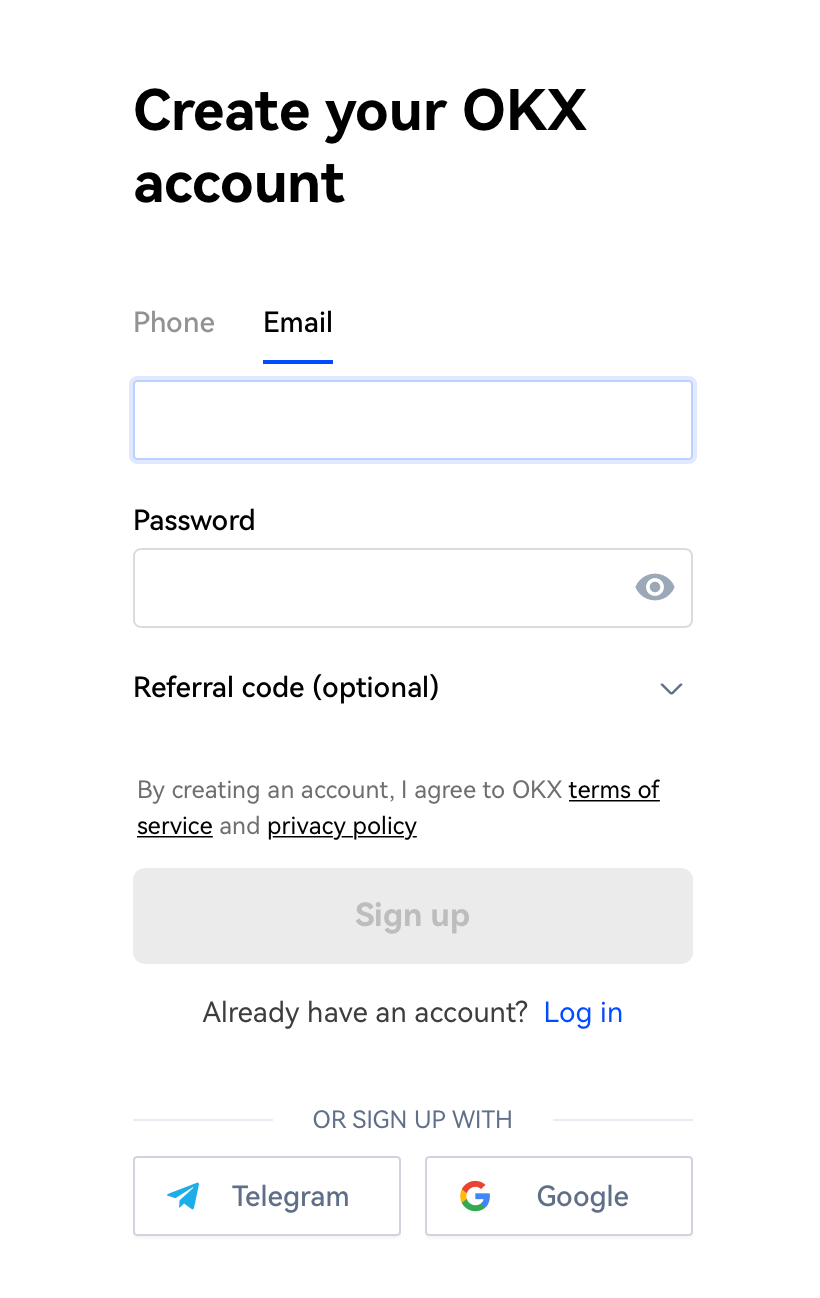
Complete the captcha and go through a two-step verification — either by an emailed link or an SMS code. At this point the account is formally created, but KYC is still required for full functionality.
Go to profile settings and start Identity Verification. The system will prompt you to choose your country of residence, enter your full name and document details, and upload a scan or photo of the document. The Advanced tier also requires a selfie with the document. The Pro tier (maximum limits) requires a brief video call with a support agent.
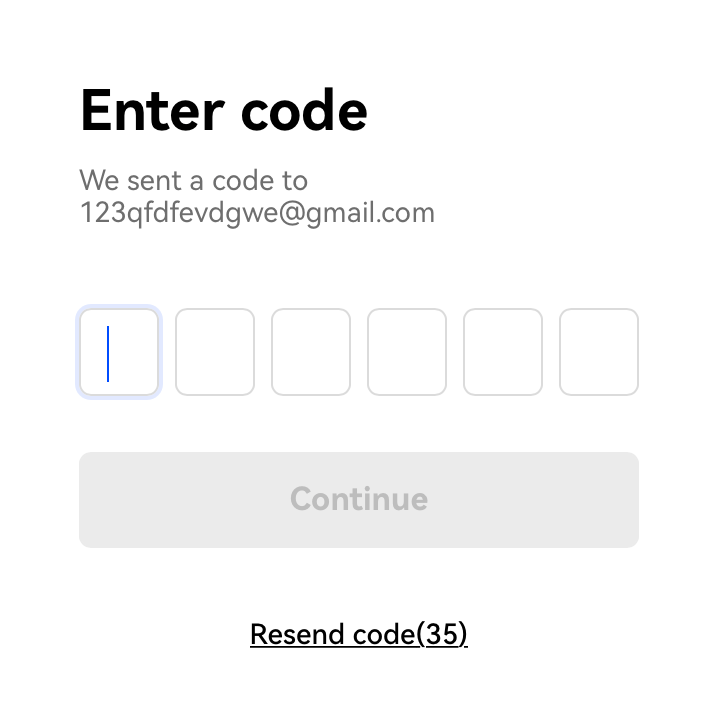
In most cases, Basic is approved automatically within minutes, Advanced takes an hour or two, and Pro can take up to 24 hours.
Verification on OKX
If in 2022 OKX operated with two KYC tiers, there are now three:
| Tier | Requirements | Restrictions |
|---|---|---|
| Unverified | Email/phone only. | Trading unavailable; crypto withdrawal blocked. |
| Basic | Country, full name, document, ID number. | Basic trading and capped withdrawals (equivalent of up to $10,000/day, depending on the asset and region). |
| Advanced | Document scan/photo + selfie. | Access to fiat operations, P2P, and higher daily limits (up to several hundred thousand USD). |
| Pro | Video call + proof of address documents. | Maximum limits (several million USD per day), access to institutional tools, Portfolio Margin. |
OKX does not hard-fix the limits: they can be recalculated algorithmically depending on trading volume, region, and VIP status. The figures above are typical reference points; the actual numbers are always displayed in the user's dashboard.
Minimum Deposit on OKX
There is no set minimum deposit on OKX — the platform does not require a specific starting amount. Only per-network minimums exist (for example, a USDT-TRC20 deposit below 2 USDT will simply not be confirmed by the network).
| OKX | Binance | Bybit | |
|---|---|---|---|
| Minimum Deposit | None | ~$10 | ~$1 |
For comparison: on Binance there is no formal minimum for crypto, but most fiat methods start at $10. Bybit allows symbolic amounts starting from $1. In practice, the more meaningful constraint is the minimum order size — roughly $5–10 USD equivalent on most OKX spot pairs.
OKX Account Types
Upon registration, users get a single Unified Trading Account (UTA) — another important upgrade compared with 2022. Previously, funds had to be shuffled between separate wallets (spot, futures, options); now they live in a shared balance, with margin allocated automatically. The account-mode setup is user-selectable:
- Simple mode — for beginners: spot only and basic buying flows.
- Single-currency margin — one currency serves as margin across all markets.
- Multi-currency margin — several currencies can act as margin simultaneously.
- Portfolio Margin — a risk-based model, available from $10,000 in equity.
Internal transfers between sub-accounts remain free, and institutional clients have access to a Master-Sub structure with separate API keys and limits.
Deposit and withdrawal on OKX
The deposit and withdrawal toolset in 2026 is one of the broadest in the industry. Alongside classic crypto deposits and bank cards, OKX now supports SEPA, SWIFT, AED, Apple Pay, Google Pay, a P2P marketplace covering 100+ currencies and 800+ payment methods, and OKX Pay for instant internal transfers between users.
Deposit and Withdrawal Methods and Processing Times
| Method | Fee | Processing Time |
|---|---|---|
| Bitcoin, Ethereum, and other blockchains | Deposit — 0 (network fee only). Withdrawal — network fee + small flat fee. | From a few minutes to about an hour, rarely longer. |
| SEPA / SWIFT / AED | No OKX fee (the bank may charge its own). | SEPA — up to 1 business day; SWIFT — up to 3 business days. |
| Bank cards (Visa/Mastercard via Banxa, Moonpay and others) | 1.5–3% on top of the market rate, plus bank fee. | Up to a few hours. |
| Apple Pay / Google Pay | Depends on the gateway (typically 2–3%). | A few minutes. |
| P2P (100+ currencies, 800+ payment methods) | 0 for both sides (maker's spread). | A few minutes to an hour. |
| OKX Pay | 0. | Instant. |
OKX Trading Platforms
Over four years, the OKX client lineup has grown. In 2022, the exchange had only a web interface and a mobile app; today those are complemented by a dedicated Desktop Client for Windows and macOS, TradingView integration (including on mobile), and extended APIs — REST, WebSocket, and FIX for institutional clients.
Feature Comparison Table
| Web | Mobile | Desktop | |
|---|---|---|---|
| Two-factor authentication | + | + | + |
| Timeframe range | from 1 sec to 1 month | from 1 min to 1 month | from 1 sec to 1 month |
| Order types | Limit, Market, Stop, Trigger, Iceberg, TWAP, OCO, Trailing Stop, Post-only | same | same |
| Price history | + | + | + |
| TradingView indicators | + | + | + |
| Native charts | + | + | + |
Comparison with Competitors
| OKX | Binance | Bybit | |
|---|---|---|---|
| Web platform | Yes | Yes | Yes |
| Android | Yes | Yes | Yes |
| iOS | Yes | Yes | Yes |
| Desktop | Yes | Yes | Yes |
| TradingView mobile integration | Yes | No | No |
| API (REST / WS / FIX) | Yes | Yes | Yes |
OKX is one of the few top-10 exchanges to deliver full mobile integration with TradingView: users can open and close positions directly from the TradingView app without switching to the exchange client. That's valuable for scalpers working multiple markets simultaneously.
Web Platform
The OKX web interface is a "Swiss Army knife" of a client. The main sections (Trade, Futures, Options, Earn, Copy Trading, NFT, Web3) are grouped in the top menu; each trading screen supports multiple layout presets and easy widget rearrangement. Dark and light themes are supported, along with internal search, keyboard shortcuts, and a mobile-adapted view (for users who choose to log in from a phone without the app).
Mobile Platform
The OKX mobile app is optimized for both Android and iOS. Functionality is almost mirrored across platforms: users get access to all markets, all order types, Copy Trading, and Trading Bots. A Simple mode caters to beginners — offering one-click purchases of 350+ assets — while Pro mode handles full derivatives trading.
App store ratings are telling: on the App Store, OKX sits around 4.6 out of 5 — a strong result for a CEX of this functional depth. On Google Play the rating is more modest at 3.9 out of 5; typical complaints focus on periodic bugs after updates and regional issues with push notifications.
Desktop Client
A dedicated Windows/macOS application appeared after 2022 and addresses the needs of professional traders who outgrew the web version. The client supports multi-monitor layouts, trading hotkeys, local history caching, and faster chart rendering on heavy strategies.
OKX Analytics
The OKX analytics section has advanced significantly over four years. Alongside standard market data and news feeds, several serious tools have been added:
- OKLink — the proprietary on-chain explorer covering dozens of networks. It tracks transactions, balances, cross-wallet relationships, and the activity of major players.
- Whale Tracker inside OKX Wallet — monitors "smart-money" wallets and pushes alerts when a major address opens or closes a position in a tracked asset.
- OKX Research — regular analytical publications from the OKX team: macro overviews, tokenomics breakdowns, new-project launch assessments.
- TradingView integration — access to all popular indicators, pine-script strategies, the alert system, and third-party trading ideas.
- Exchange rankings — a Top Gainers / Losers / Volume section with category filters (DeFi, AI, Layer 2, GameFi, RWA, Meme).
OKX Education
If in 2022 OKX's education offering was limited to help-center articles and scattered publications, today the exchange has a full-fledged educational hub — OKX Learn. It organizes beginner guides, advanced strategy breakdowns, an industry glossary, Web3 courses, and dedicated materials for niche products (options, Portfolio Margin, Pre-market Futures, and others).
Alongside that, there is a YouTube channel with regular videos (listing reviews, market breakdowns, Earn mechanic explainers), an OKX Insights podcast series, and the Tenfold program — a series of case interviews with top traders and Web3 projects.
OKX Customer Support
OKX customer support has transformed over four years. In 2022, the only live-chat language was English and many users complained about boilerplate responses; today the exchange runs a 24/7 live chat with multilingual agents — covering English, Spanish, Portuguese, French, German, Arabic, Chinese, Korean, Kazakh, and around 15 other languages.
The service is not perfect yet: at peak load, the first-line bot response can feel templated, and handoff to a live agent is not always instant. But compared with 2022, when some users could not get a coherent response at all, the progress is clear.
Communication Channels
For contacting support, users can use:
- live chat on the website and mobile app (24/7);
- the email address [email protected] and specialized addresses ([email protected], [email protected]);
- official social channels (X/Twitter, Telegram, Discord, Reddit);
- a dedicated ticket form in the Help Center.
Support Languages
| Language | Channel |
|---|---|
| English | Live chat 24/7, email, social media |
| Simplified and Traditional Chinese | Live chat, WeChat |
| Spanish, Portuguese, German, French | Live chat 24/7, email |
| Arabic, Turkish, Korean | Live chat 24/7 |
| Kazakh, Ukrainian, Polish, Italian, Indonesian, Vietnamese, Thai, and others |
Live chat |
OKX Bonuses and Promotions
OKX regularly runs tournaments, listing campaigns, and activity events around new products. The main ongoing promotion is the multi-tier referral program: the invited friend receives a welcome bonus, while the inviter gets a share of the referred user's trading fees. In addition, there are:
- Jumpstart — access to new token sales for OKB holders.
- Learn & Earn — educational tasks: watch a short video, take a quiz, receive a portion of a new token.
- Mystery Boxes — prize boxes awarded for completing quests, with rewards ranging from a few USDT to full-featured altcoins.
- Trading Competitions — regular futures tournaments with prize pools running from hundreds of thousands to several million dollars.
A separate layer is the brand and partnership marketing. OKX's brand ambassador is Cristiano Ronaldo, and the exchange's sports partnerships include Manchester City and the McLaren Formula 1 team. These aren't direct trader perks, but they illustrate how far the exchange's positioning has shifted since 2022.
Summary
OKX arrives at 2026 as a very different exchange from the one reviewed in 2022. Once an international offshore platform with no licenses, it has become a multi-regulated company holding a full MiCA license, regulated status in the UAE, the Bahamas, Singapore, and the United States, monthly transparent Proof of Reserves, and its own Layer 2 blockchain. The $500 million DOJ settlement is a painful but closed chapter — after it, the exchange returned to the U.S. market under proper licensing and kept its CEO in place, which — against the backdrop of comparable cases on rival platforms — looks more like a plus. And the March 2026 investment by Intercontinental Exchange (the NYSE parent) cemented OKX's standing with traditional financial institutions.
From a product perspective, OKX today is one of the most versatile platforms in the industry. It is comfortable for beginners: Simple mode, step-by-step verification, a P2P marketplace for fiat, and the large OKX Learn educational hub. Active traders get the full derivatives stack, options on BTC/ETH/SOL, Pre-market Futures, 125x leverage, and one of the deepest portfolio-margin solutions in the industry. Web3 users benefit from a non-custodial wallet spanning 60+ networks, an NFT aggregator with 0% fees, and a proprietary Layer 2 with OKB as the gas token. Institutional clients have access to RFQ block trading, FIX API, a Master-Sub structure, an OTC desk with structured products (launched in 2026), and dedicated licensed entities.
The platform has limitations, too. Baseline spot fees in the EEA are noticeably higher due to MiCA rules; Japan is fully closed; several U.S. states are off-limits; Canada is unavailable for new registrations. The incident history of 2023–2025 shows that even with monthly PoR reports, OKX still has exposure — particularly on the Web3 side, where DEX contracts and user wallets remain under constant pressure from malicious actors.
Put it all together, and OKX today sits confidently among the three strongest global CEXs — alongside Binance and Bybit. An active trader, a Web3 enthusiast, or any user who values low fees, product breadth, and transparent regulation can reasonably treat the platform as a primary working venue. Those particularly sensitive to the DOJ episode or operating from jurisdictions with restrictions should double-check product availability before signing up.