
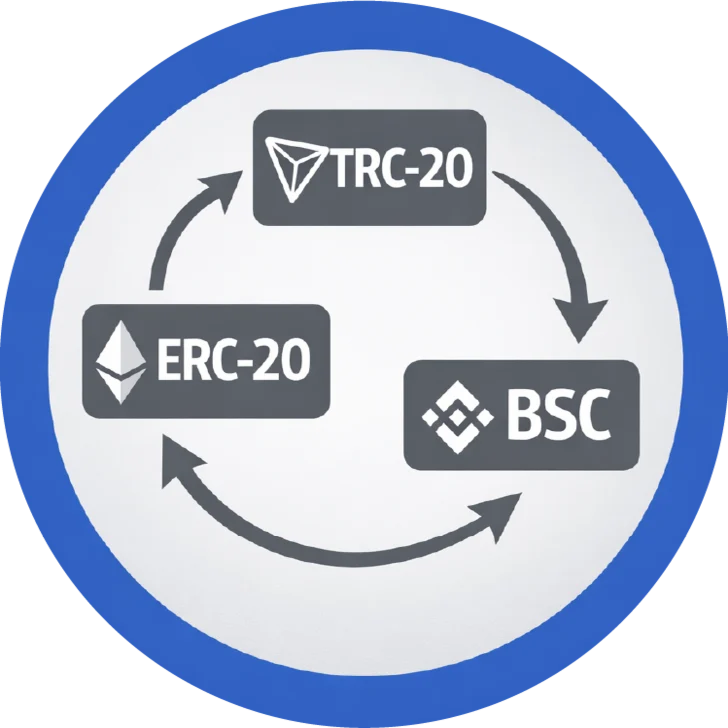
TRC-20 vs ERC-20 vs BSC: The Cheapest Way to Transfer USDT in 2026
Sending 100 USDT can cost you 5 cents or 5 dollars — the only difference is which network you choose. TRC-20, ERC-20, and BEP-20 (BSC) all use the same token (e.g., USDT) but run on different blockchains with radically different fee structures. In this guide, we break down the real-world fees, speeds, and risks of each network as of March 2026 — no technical jargon overload, just hard numbers and practical examples.
Key Takeaways (30-Second Summary)
- TRC-20 (Tron) — Popular for transfers, but "zero fees" is a myth: without staking TRX, a transfer costs $3–6
- ERC-20 (Ethereum) — The safest and most expensive option: fees range from $5 to $50, but institutional players pay for guarantees
- BEP-20 (BSC) — The sweet spot: fees of $0.05–$0.50, fastest speeds of the three
- L2 networks (Arbitrum, Base) — The new contenders: $0.04–$0.09, with Ethereum-grade security and BSC-level speed
- The biggest risk — Sending tokens on the wrong network and losing access to your funds
What Are Token Standards, and Why Are There Three?
All three standards (TRC-20, ERC-20, BEP-20) are sets of rules governing how tokens operate on different blockchains. Think of them as file formats: the same movie can come in MP4, AVI, or MKV — same content, different players.
USDT across three networks:
- USDT TRC-20 — Runs on the Tron blockchain
- USDT ERC-20 — Runs on the Ethereum blockchain
- USDT BEP-20 — Runs on BNB Smart Chain (Binance)
Important: this is the same Tether dollar, just in different "wrappers." Sending USDT TRC-20 to an ERC-20 address is like plugging a USB stick into an HDMI port: it won't fit (or you'll lose your funds).
TRC-20 (Tron): "Free" Transfers with a Catch
How It Works
Tron was built with a single purpose: maximum throughput at minimum cost. The network processes transactions in 3 seconds and charges not in currency but in resources: Bandwidth and Energy.
Resource Model:
- Bandwidth — 5,000 free units per day (enough for 1–2 TRX transfers)
- Energy — Required for smart contracts (a USDT transfer = a smart contract call). There is no free Energy.
Real-World Costs
| Scenario | USDT Transfer Cost | How It Works |
|---|---|---|
| No preparation | $3–6 | The network burns your TRX to pay for Energy (~30–65K units) |
| With TRX staking | $0 | Freeze $300–400 worth of TRX → receive Energy that regenerates every 24 hours |
| Energy rental | $0.30–0.80 | Rent Energy from large holders via JustLend DAO or TronPulse |
Bottom line: Tron's "zero fee" promise only works if you keep capital locked in staking or rent resources. For a one-time user, TRC-20 can actually be more expensive than BSC.
TRC-20 Pros and Cons
| ✅ Pros | ❌ Cons |
|---|---|
| Predictable costs (if you have a stake) | Expensive without staking ($3–6) |
| Broad exchange support | Complex resource model (confusing for beginners) |
| 50%+ of all USDT runs on Tron | Centralization risks (only 27 validators) |
| Fast (3-sec block time, 57-sec finality) | Regulatory risks (SEC vs. Justin Sun) |
When to choose TRC-20:
- You transfer stablecoins regularly (staking will pay for itself)
- You're moving funds between exchanges (they maintain their own stakes; withdrawal fees are often a flat $1)
- You work with peer-to-peer (P2P) trading (the de facto standard in emerging markets)
ERC-20 (Ethereum): Premium Service at a Premium Price
How It Works
Ethereum is the "gold standard" of decentralization. Since its transition to Proof of Stake (2022) and the 2025–2026 upgrades (Glamsterdam, Hegota), the network has evolved into the global settlement layer for the crypto industry.
Key Figures:
- Validators: 968,000+ (compare: Tron has 27, BSC has ~21)
- Block time: 12 seconds
- Finality: 12–15 minutes (mathematically guaranteed irreversibility)
Real-World Costs
USDT ERC-20 transfer fees as of February 2026:
- Normal conditions: $5–8
- Peak load (NFT mints, memecoin rushes): $15–50+
Why so expensive? Every action on Ethereum costs "gas" (Gas). Block space is limited, but demand is high → the price rises like an auction. During bull markets, thousands of users simultaneously try to buy the latest token, and fees skyrocket.
ERC-20 Pros and Cons
| ✅ Pros | ❌ Cons |
|---|---|
| Maximum security and decentralization | High fees ($5–50) |
| The backbone of DeFi (Uniswap, Aave, Compound) | Slow finality (12–15 min) |
| Institutional trust | Volatile fees (unpredictable) |
| Deepest liquidity | Not cost-effective for small amounts (<$500) |
When to choose ERC-20:
- You're transferring large sums (>$10,000) — security outweighs the fee
- You interact with DeFi protocols (the majority run on Ethereum)
- Institutional custody (custodians require ERC-20)
- You need maximum transaction irreversibility guarantees
BEP-20 (BSC): Speed and Balance
How It Works
BNB Smart Chain (formerly Binance Smart Chain) was created as a high-performance alternative to Ethereum within the Binance ecosystem. In 2025–2026, the network underwent aggressive upgrades (Pascal, Lorentz, Maxwell), making it the fastest blockchain among these three.
Key Figures After the 2025 Upgrades:
- Block time: 0.45 seconds (27 times faster than Ethereum!)
- Finality: 1.125 seconds
- Validators: ~21 active (rotating every 24 hours)
2026 Target: 20,000 transactions per second (TPS) via parallel execution.
Real-World Costs
USDT BEP-20 transfer fees:
- Normal conditions: $0.05–$0.20
- Peak load: $0.30–$0.50
That's 10 to 100 times cheaper than Ethereum and more price-stable than TRC-20 without staking.
BEP-20 Pros and Cons
| ✅ Pros | ❌ Cons |
|---|---|
| Lowest fees ($0.05) | Lower decentralization (~21 validators) |
| Fastest speeds (0.45-sec block time) | Tied to the Binance ecosystem |
| Seamless integration with Binance CEX | Lower security compared to Ethereum |
| Active ecosystem (PancakeSwap, GameFi) | DeFi protocols are less thoroughly audited |
When to choose BEP-20:
- Frequent trading (day trading, arbitrage)
- Working with memecoins and new token launches
- Mid-range transfers ($100–$5,000)
- Speed is critical (gaming, betting, quick swaps)
Side-by-Side Comparison: All Networks at a Glance
| Parameter | TRC-20 (Tron) | ERC-20 (Ethereum) | BEP-20 (BSC) |
|---|---|---|---|
| Fee (normal) | $0 (with staking) / $3–6 (without) | $5–8 | $0.05–$0.20 |
| Fee (peak) | $0.30–$0.80 (rental) | $15–50+ | $0.30–$0.50 |
| Block time | 3 sec | 12 sec | 0.45 sec ⚡ |
| Finality | 57 sec | 12–15 min | 1.1 sec ⚡ |
| Decentralization | ⭐⭐ (27 nodes) | ⭐⭐⭐⭐⭐ (968K+ nodes) | ⭐⭐⭐ (~21 nodes) |
| Security | Medium | Maximum | Above average |
| Exchange support | ★★★★★ | ★★★★★ | ★★★★☆ |
| DeFi ecosystem | Narrow (JustLend) | Massive (Uniswap, Aave) | Moderate (PancakeSwap) |
| Best for | P2P, inter-exchange transfers | Large sums, DeFi | Trading, memecoins |
The New Player: L2 Networks (Arbitrum, Base)
In 2026, you can't afford to ignore Layer 2 solutions for Ethereum. These are separate networks that "inherit" Ethereum's security while operating faster and cheaper.
Key L2 Networks:
- Arbitrum One — The oldest and most battle-tested
- Base — Backed by Coinbase, experiencing rapid growth in 2025–2026
- Optimism — Focused on public goods and grants
L2 Metrics (February 2026):
- Fees: $0.04–$0.09
- Finality (soft): 0.25 seconds
- Security: Inherited from Ethereum
Bottom line: L2 networks offer BSC-level speed with Ethereum-grade security at a lower cost than either. They are direct competitors to TRC-20 and BEP-20, especially for DeFi transactions.
Key Risks: What Can Go Wrong
Risk #1: Sending to the Wrong Network
Scenario: You sent USDT BEP-20 to an ERC-20 deposit address on an exchange.
| Situation | Loss Risk | What to Do |
|---|---|---|
| BEP-20 → ERC-20 (non-custodial wallet) | ✅ Low | Addresses are compatible (both start with 0x...). Add BSC to MetaMask and you'll see your tokens |
| TRC-20 → ERC-20 | ❗ Catastrophic | Addresses are incompatible (T... vs. 0x...). Most interfaces will block this, but if forced — funds are lost |
| Any network → Exchange (wrong one) | ⚠️ Medium | The exchange may recover funds (they control keys), but will charge a $50–500 fee — or may refuse entirely |
Golden rule: Before any large transfer, send a $1 test payment and confirm it arrives.
Risk #2: Regulatory Threats to TRON
TRON is under pressure from the SEC due to the case against founder Justin Sun. If regulators compel stablecoin issuers (Tether, Circle) to blacklist TRON, 50% of all USDT could instantly lose its utility.
Likelihood: Low in 2026, but the risk is real. Diversify — don't keep 100% of your assets exclusively in TRC-20.
Risk #3: Centralization of BSC and Tron
Both networks are controlled by a small number of validators:
- BSC: ~21 nodes (enough to potentially coordinate transaction censorship)
- Tron: 27 nodes (theoretically, 14 could collude)
What this means: In an extreme scenario, your transaction could be blocked or reversed. In Ethereum with 968,000 validators, that is practically impossible.
Practical advice: For amounts exceeding $50,000, use Ethereum (ERC-20) despite the higher fees.
How to Choose a Network on Wellcrypto
When you use the Wellcrypto exchange monitor, the system automatically displays rates for all supported networks.
Decision Framework:
Step 1: Determine Your Amount and Frequency
| Your Use Case | Recommendation |
|---|---|
| One-time transfer <$500 | BEP-20 (BSC) — cheap and fast |
| One-time transfer >$10,000 | ERC-20 (Ethereum) — security outweighs fees |
| Regular transfers (weekly) | TRC-20 (Tron) — freeze $300–400 in TRX, transfer for free |
| Inter-exchange trading | TRC-20 or BEP-20 — both are fast and affordable |
Step 2: Verify Exchange Support
In the Wellcrypto monitor, filter exchanges by your preferred network. Not all exchanges support every network — for example, many OTC exchanges only work with TRC-20 and ERC-20.
Step 3: Compare the Final Rate
The network fee isn't everything. The Wellcrypto calculator factors in:
- Exchange rate
- Exchange service fee
- Network fee
- The final amount you receive ← this is what matters
Example:
- Exchange A: TRC-20, rate 91.5 RUB/USDT, fee $1 → Total: 9,050 RUB
- Exchange B: BEP-20, rate 92.0 RUB/USDT, fee $0.10 → Total: 9,190 RUB
Common Mistakes When Choosing a Network
| Mistake | Consequence | How to Avoid |
|---|---|---|
| "TRC-20 is always cheaper" | Overpaying $3–6 without staking | Check the actual fee before sending |
| Not verifying recipient network | Funds stuck or lost | Confirm with recipient/exchange before sending |
| Choosing a network out of habit | Overpaying up to 5% on the rate | Compare rates across all networks in the monitor |
| Sending the full amount at once | Risk of total loss | First transfer should be a test ($1–10) |
| Ignoring exchange limits | Order gets stuck | Review min/max amounts for each network |
The Future: What Will Change in 2026–2027
Ethereum: L2 Will Cannibalize L1 Traffic
The Glamsterdam and Hegota upgrades (2026) are making Ethereum even more secure, but not cheaper. The real competition for TRC-20/BSC is coming from Layer 2 (Arbitrum, Base).
Forecast: By the end of 2026, 70%+ of retail USDT ERC-20 transfers will migrate to L2 networks.
BSC: On the Path to 20,000 TPS
BNB Chain is implementing parallel transaction execution. The goal is to become the fastest EVM-compatible network in the world.
Forecast: BSC will solidify its position as the standard for gaming and high-frequency trading.
TRON: Regulatory Uncertainty
Technically stable, but politically under threat due to the SEC case.
Forecast: TRC-20 will retain market share in P2P, but institutional players will steer clear.
What to Do Now
Ready to pick the optimal network for your exchange?
1. Open the Wellcrypto monitor — compare rates across all networks in 30 seconds
2. Check the network fee — TRC-20 without staking can be more expensive than BSC
3. Send a test transfer — send $1 before committing a large amount
4. Set up an alert — get notified when the rate becomes favorable
5. Diversify — don't keep all your assets on a single network
Pro tip: If you're exchanging >$1,000, use the dual-exchange calculator — sometimes the route USDT → BTC → RUB is cheaper than a direct conversion.
FAQ: Common Questions About Choosing a Network
1. Can I convert TRC-20 to ERC-20 directly? No — they are different blockchains. You need a bridge or an exchange service. The simplest method is to swap TRC-20 USDT on an exchange and then withdraw as ERC-20.
2. Why do exchanges charge $1 for TRC-20 withdrawals if it's "free"? Exchanges maintain massive TRX stakes (making the network fee $0 for them), but they charge a flat $1 as profit. This is still cheaper than the $5–10 fee for ERC-20.
3. Is it safe to use BSC with only 21 validators? For amounts under $10,000 — yes. For institutional sums (>$50,000), Ethereum is recommended for its maximum decentralization.
4. What is L2, and do I need it? L2 (Layer 2) refers to networks built on top of Ethereum (Arbitrum, Base). They are cheaper ($0.04–$0.09) and faster, while inheriting Ethereum's security. If you work with DeFi — yes, you need it.
5. How do I tell which network an address I've received belongs to?
- Starts with 0x → Ethereum (ERC-20) or BSC (BEP-20) — don't mix them up!
- Starts with T → TRON (TRC-20)
- Always confirm with the sender which network they intended.
6. What should I do if I sent funds on the wrong network?
- ERC-20 ↔ BEP-20: Add the correct network to your wallet — the tokens are there (addresses are compatible).
- TRC-20 → ERC-20: Funds may be permanently lost. Contact the recipient's support team immediately.
- Exchange: Submit a support ticket, but be prepared for a $50–500 recovery fee.
Disclaimer: This material is current as of March 2026. Exchange rates, fees, and network upgrades are subject to change. Always verify the latest information on exchange and service provider websites. This article does not constitute financial advice.